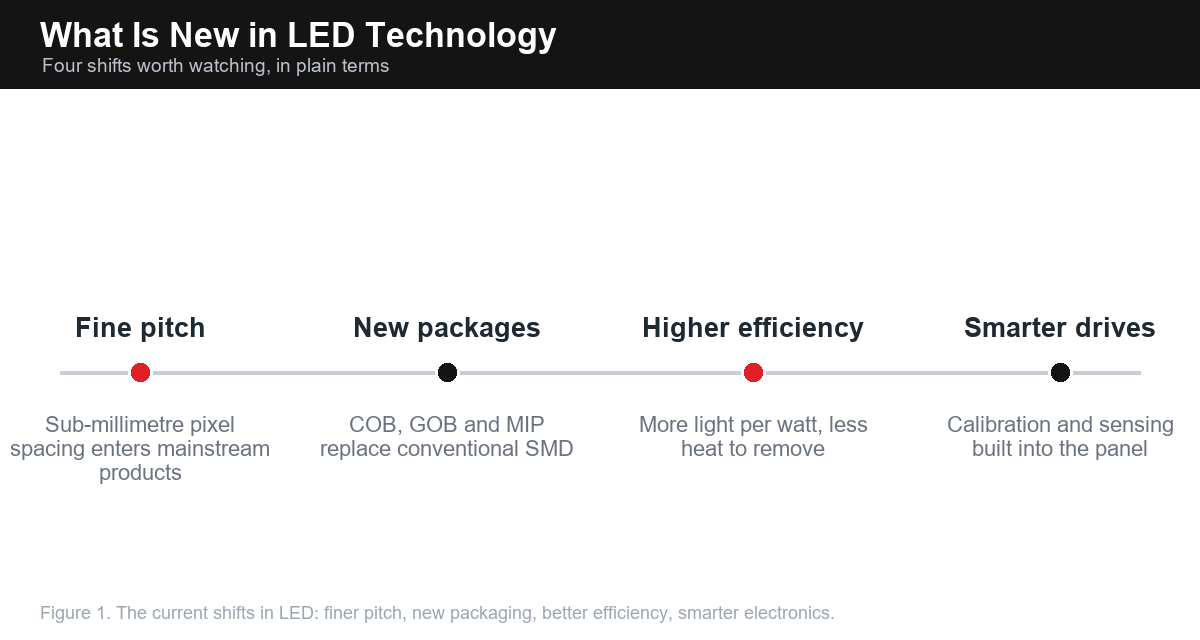
LED technology has not stood still since it replaced the bulb. The last few years have been dominated by three shifts — finer pixels, tougher packaging and higher brightness from less power — and all three are exactly what defines a modern VP LED wall. If you spec'd LED five years ago, the current generation is a different product.
1. Micro-LED and MIP Push Pitch Down
Micro-LED builds the diode at the micron scale, removing the bulky package entirely so pixels can sit almost touching. MIP (Micro LED in Package) shrinks that same die into a protected mini-package that is still fine enough for sub-millimetre pitch. Our MIP P0.9 runs at 600–1,000 nits indoors at a pitch most walls could not touch a few years ago.
2. COB and GOB Make Walls Tough
COB (Chip-on-Board) bonds the diodes straight to the board and seals them under one flat surface — almost no dead space, so fine pitch stays bright and the panel shrugs off moisture and impact. GOB adds a clear glue layer over SMD for rental and rough sites. Both are why a wall can be fine-pitch and field-rugged at once.
3. Brightness Keeps Climbing on Less Power
| Generation | Typical brightness | What changed |
|---|
| Early SMD | ~1,500–3,000 nits outdoor | First mainstream outdoor walls |
| COB outdoor | 4,500–5,000 nits (custom 14,000) | Sealed surface keeps fine pitch sunlight-bright |
| MIP / Micro-LED | 600–1,000 nits indoor, sub-mm pitch | Finer pixels, lower power per pixel |
4. Calibration and Control Got Smarter
Per-module colour and brightness calibration, combined with finer greyscale and higher refresh, means a wall looks uniform edge to edge and films cleanly on camera — a requirement for broadcast and live events that older walls failed.
What This Means for Your Spec
You can now ask for things that were impossible together a few years back: fine pitch and outdoor brightness, rental ruggedness and seamless surface, daylight readability and reasonable power. Our COB Outdoor P1.5 is the example — P1.2 / P1.5 / P1.9 in both fixed and rental, holding 4,500–5,000 nits in daylight.
Technical Note: Density, Bandwidth and Power per Pixel
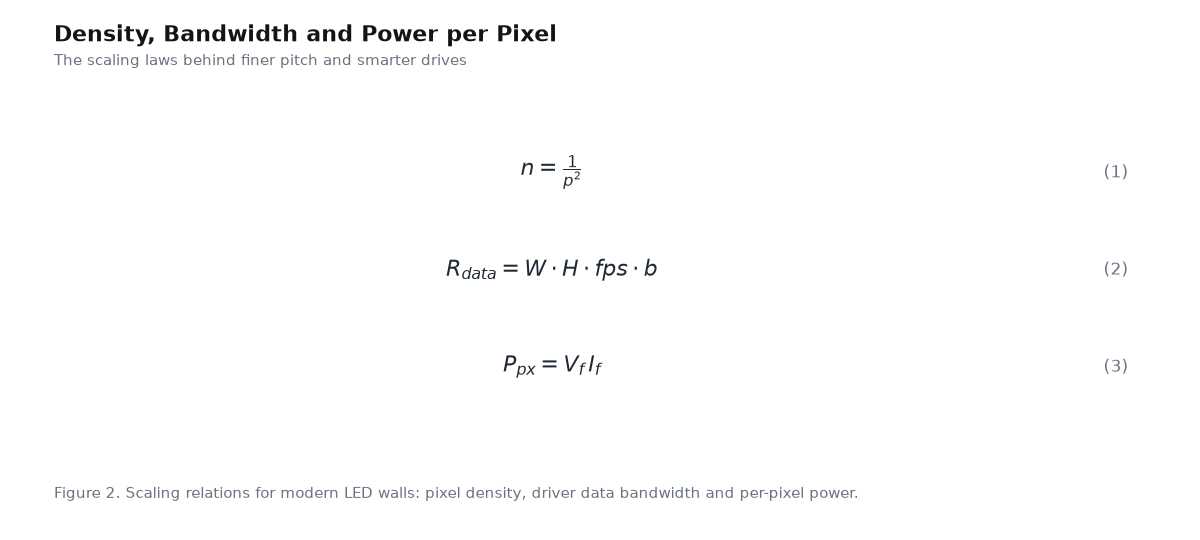
Equation (1) is the density law: halving pitch p quadruples the pixel count per square metre. Equation (2) is the driver data rate a wall demands - width times height times frame rate times bits per channel - which is why fine pitch pushes receiver-card bandwidth as hard as diode manufacture. Equation (3) is per-pixel power: forward voltage Vf times forward current If, summed over millions of pixels it becomes the wall's thermal design problem.
Request a Quote
Tell us what "new" you need — finer pitch, more brightness, or tougher build — and we will map it to the right VP LED product.
Email: info@visionprox.com
Related Reading
References & Standards
Authoritative background and standards on the technologies discussed above:
Academic References
Peer-reviewed and preprint research supporting the technical points above:
Hwang, J. et al. Wafer-scale alignment and integration of micro-light-emitting diodes using engineered van der Waals forces. Nature Electronics 6, 216-224 (2023).
Zhang, X.-F.; Bai, W.-W.; Qu, S. High Resolution 1024x768 Micro-LED Display Using Flip-Chip Bonding. 2024 25th Int'l Conf. on Electronic Packaging Technology (ICEPT).
Lee, T.-Y.; Kuo, H.-C. et al. Technology and Applications of Micro-LEDs: Their Characteristics, Fabrication, Advancement, and Challenges. ACS Photonics 2022.
Related VP LED products: MIP P0.9 Micro LED Display · TX P0.9 Indoor Fixed LED Display · TWS P3.91×7.8 Transparent LED Display


