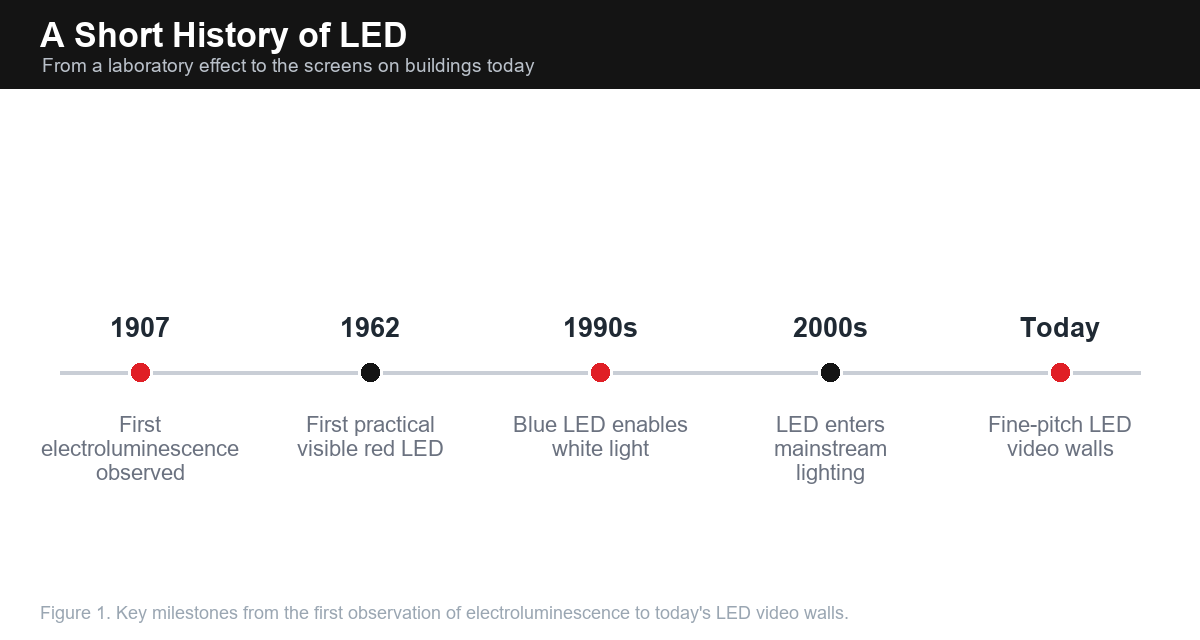
The LED did not arrive fully formed. It is the product of six decades of materials science, and the story matters because each breakthrough is what lets a modern wall do what it does — from the first red glimmer to sub-millimetre micro-LED.
A Short Timeline
| Year | Milestone |
|---|
| 1962 | First practical red LED (visible-spectrum semiconductor light) |
| 1970s–80s | Green and yellow LEDs; early indicator and display use |
| 1990s | Efficient blue LED, enabling blue + phosphor white light |
| 2000s | White LEDs for lighting; first large LED video walls |
| 2010s | Fine-pitch SMD walls; COB packaging for seamless surfaces |
| 2020s | Micro-LED and MIP push pitch below 1mm; outdoor COB past 5,000 nits |
Why the Blue LED Was the Turning Point
Red and green alone cannot make white. Once efficient blue existed, a blue die with a yellow phosphor produced white light — and the same RGB trio became the basis of every full-colour screen. That is the moment LED stopped being an indicator and became a general light source and display.
From Indicator to Wall
Each step — brighter dies, tighter packaging, better drivers and calibration — moved the LED from a status light to a seamless, sunlight-readable surface. Today's COB outdoor panels at 4,500–5,000 nits (custom to 14,000) and indoor MIP walls at P0.9 are the direct descendants of that 1962 red dot.
Technical Note: The Photon Budget: Two Constants
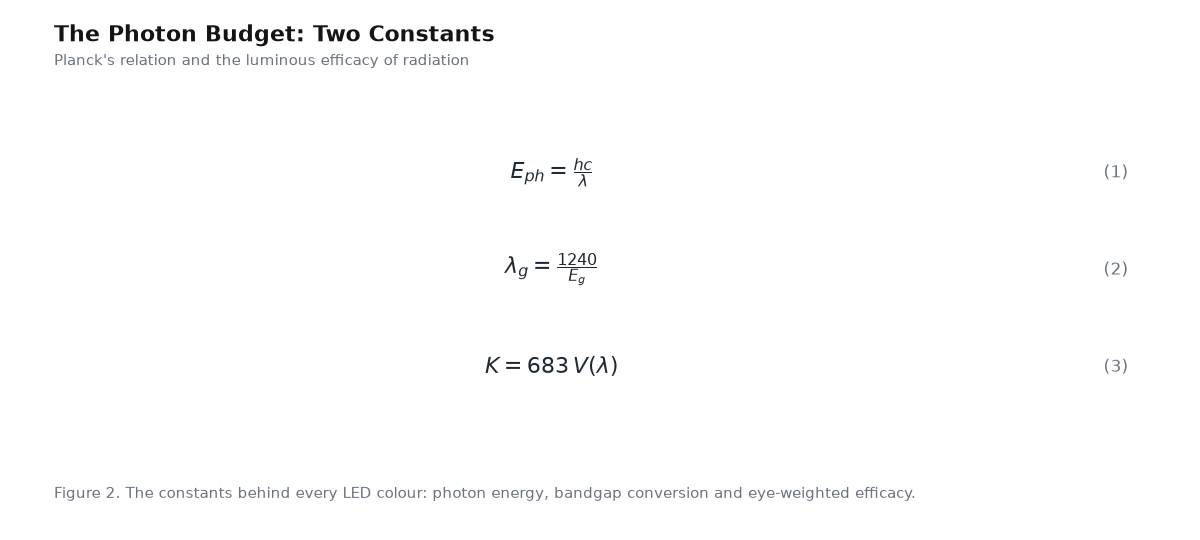
Equation (1) is Planck's relation: a photon of wavelength λ carries energy hc/λ, so blue photons cost more energy per quantum than red. Equation (2) restates it for semiconductors, converting bandgap in eV to wavelength in nm via 1240. Equation (3) is the eye's weighting: the luminous efficacy of radiation K equals 683 lm/W times the photopic value V(λ) - which explains why early red LEDs crossed 10 lm/W decades before blue could approach white light at all.
Request a Quote
Whether you need a proven SMD wall or the latest fine-pitch COB/MIP build, send us your size, distance and conditions and we will specify it.
Email: info@visionprox.com
Related Reading
References & Standards
Authoritative background and standards on the technologies discussed above:
Academic References
Peer-reviewed and preprint research supporting the technical points above:
Related VP LED products: CBV P1.95 COB Rental LED Display


