
Support
SMD stands for surface-mount device, and in LED displays it refers to the packaged pixel that is soldered directly onto the module board. A modern SMD pixel is "3-in-1": the red, green and blue LED dies sit inside a single plastic package, which is then surface-mounted as one component. That is why SMD walls look like a continuous field of identical tri-colour dots rather than separate red, green and blue lamps.
SMD replaced the older DIP (through-hole) packaging, where each colour was a separate round lamp poking through the board — the look you still see on coarse P10/P16 billboards. DIP is robust and very bright per lamp, but its bulk caps pitch at roughly P6 and above. SMD's smaller footprint is what made fine-pitch indoor walls practical in the first place.
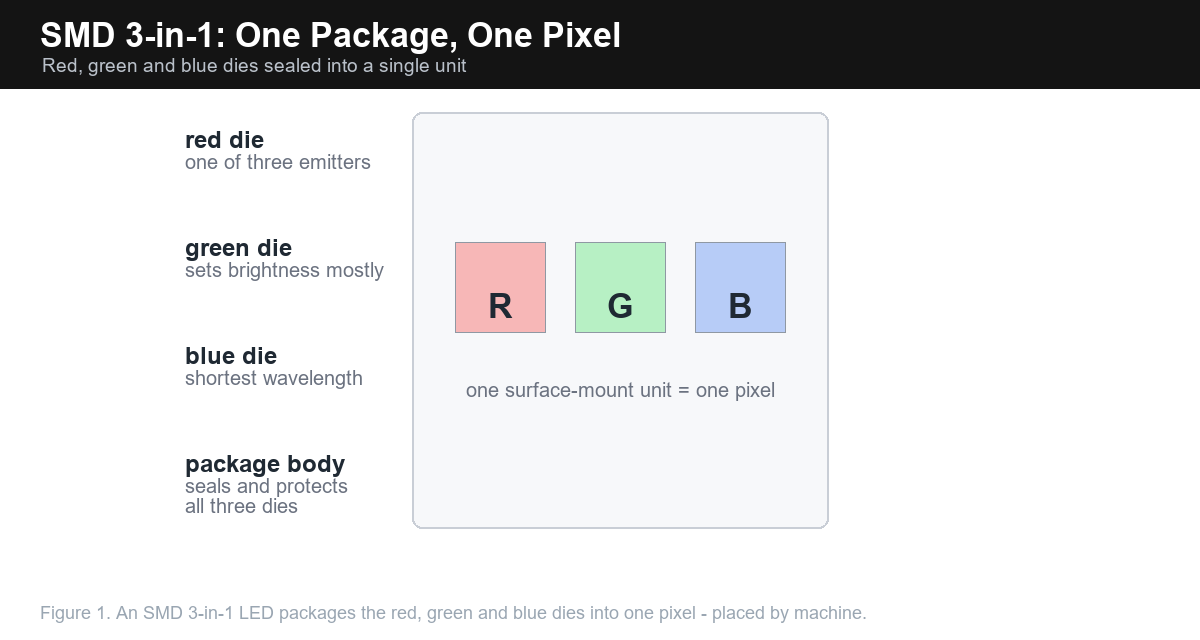
Strengths of SMD
Mature and cost-effective. SMD is the high-volume default, so it carries the lowest cost per pixel for the bulk of indoor and many outdoor walls.
Wide viewing angle. The 3-in-1 package spreads light broadly, so colour and brightness hold far off-axis.
Good fill for its class. Compared with DIP, SMD packs pixels far tighter, enabling pitches down to the low millimetres.
The Limit SMD Hits
Every SMD package has a black matrix around the three dies, and that non-emitting border sets a floor on how fine the pitch can go — practically around P1.5–1.8 for a clean image. Below that, the black gaps dominate and brightness per pixel drops, which is exactly why fine-pitch and high-brightness outdoor moved to other packaging.
| Packaging | Practical min pitch | Best role |
|---|---|---|
| SMD | ≈ P1.5–1.8 | Cost-effective default for most walls |
| GOB | ≈ P1.2 | Rental and rough environments (glue layer over SMD) |
| COB | ≈ P0.9–1.2 | Fine-pitch indoor and high-brightness outdoor |
| MIP | P0.9 | Micro-LED, finest commercial pitch |
VP LED's Packaging Range
We keep SMD in the lineup as the cost-effective workhorse, but we also build COB for seamless fine-pitch and high-brightness outdoor, GOB for rental ruggedness, and MIP down to P0.9 (see the MIP P0.9). Choosing the package is part of choosing the pitch — see our pixel pitch guide for how the two interact.
Technical Note: The Diode Equation and Junction Heat
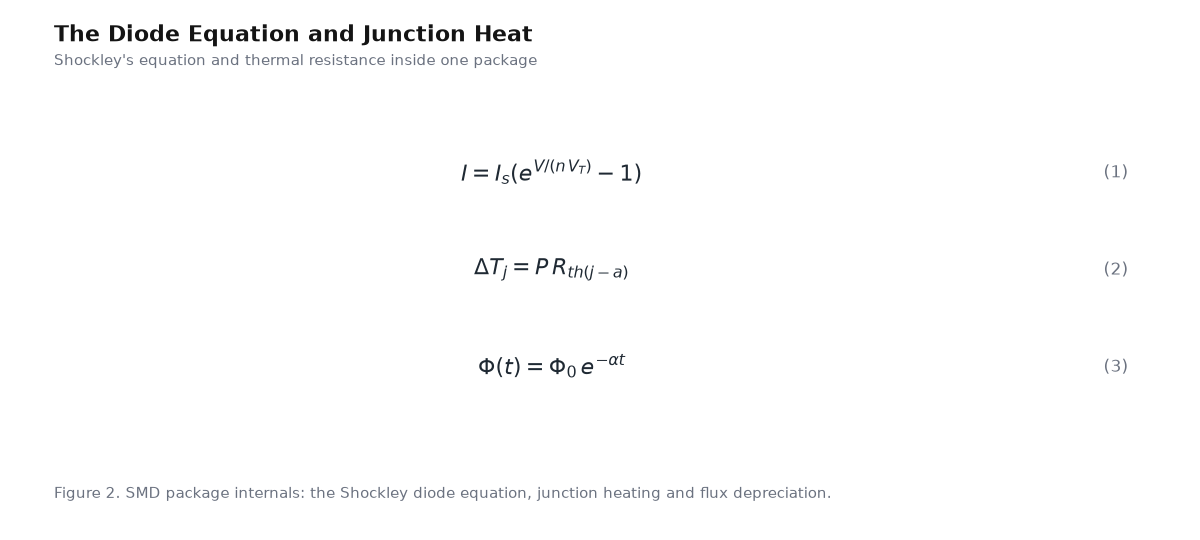
Equation (1) is the Shockley diode equation: current rises exponentially with forward voltage, with VT = kT/q about 26 mV at room temperature - the reason LED drive needs constant-current control rather than a plain voltage source. Equation (2) gives the junction temperature rise from dissipated power times thermal resistance junction-to-ambient, the number that decides how hard a package can be driven. Equation (3) is the resulting exponential flux depreciation at rate α.
Frequently Asked Questions
Is SMD outdated?
No. It remains the right choice for the majority of walls where cost matters more than sub-2mm pitch. COB and MIP extend the range SMD cannot reach, rather than replacing it.
Why does fine pitch need COB or MIP?
Because the SMD package's black border caps usable pitch near P1.5–1.8. Removing the package — as COB and MIP do — is what lets pitch fall to P0.9 while keeping brightness.
Request a Quote
Tell us your pitch target, indoor/outdoor and fixed/rental needs. We will recommend the right packaging — SMD, GOB, COB or MIP — with a transparent quote.
Email: info@visionprox.com
Related Reading
References & Standards
Authoritative background and standards on the technologies discussed above:
Academic References
Peer-reviewed and preprint research supporting the technical points above:
Related VP LED products: CRV P1.95 Rental LED Display · P8 SMD Outdoor LED Display
© 2011-2026 Vision Productions Co.,Ltd | All Rights Reserved

XINHONGFENG INDUSTRIAL PARK, LOUGANG AVENUE, LOUGANG COMMUNITY, SONGGANG BOULEVARD, BAO'AN DISTRICT, SHENZHEN, PRC.
+86-0755-28281147


