
Support
An LED display is a video wall built from panels of light-emitting diodes. Unlike an LCD or a projector, it has no backlight and no liquid-crystal layer — every pixel makes its own light and its own colour. That single fact is why an LED wall can run edge-to-edge at any size, hold its colour from any viewing angle, and be driven to brightness levels the other two technologies cannot touch.
At VP LED we build high-brightness walls for exactly that last reason. Our indoor panels run 600–1,000 nits; our outdoor COB series starts at 4,500 nits and reaches 5,000 nits as standard, with custom daylight builds available up to 14,000 nits for direct-sun and high-ambient-light sites. If you only remember one thing, remember this: an LED display is the only large-format screen you can spec for full sunlight and still read at noon.
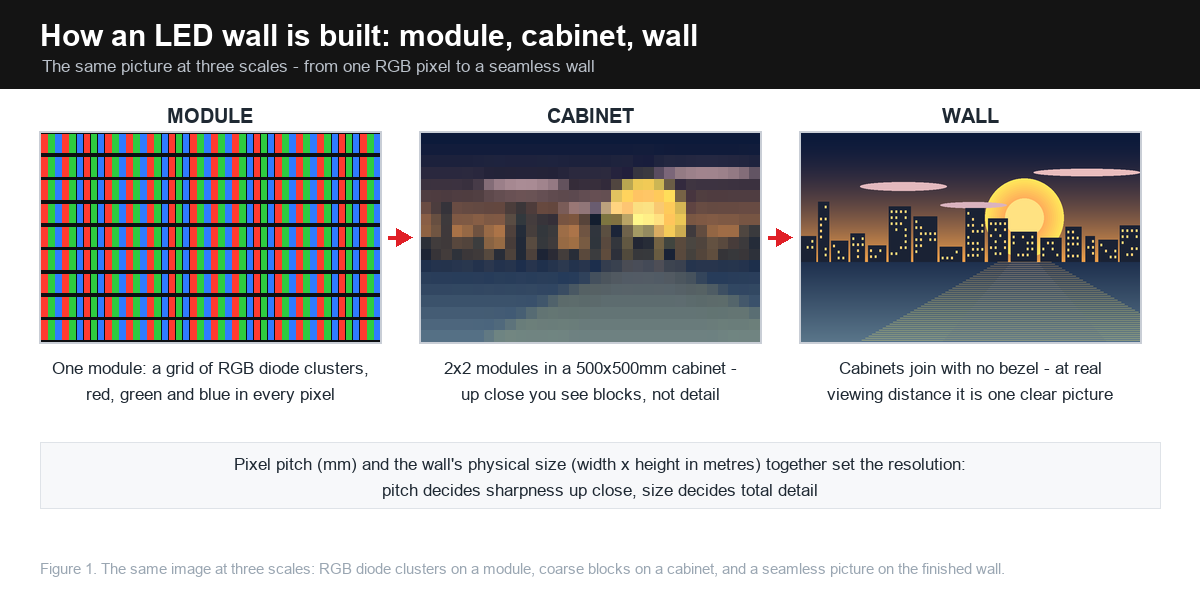
How the Image Is Built: Module → Cabinet → Wall
The picture starts small. A module is a grid of RGB diode clusters on a single board. Several modules lock into a cabinet — our standard die-cast aluminium cabinet is 500×500mm, which keeps seams tight and the wall flat. Cabinets then join into one continuous surface; because there is no bezel between them, the wall reads as a single image rather than a grid of screens. The resolution of that image is set by two things together: the pixel pitch — the gap between diode clusters, measured in millimetres — and the physical size of the wall. Pitch decides how many pixels sit in every square metre; the wall's width and height decide how many square metres there are. A 6m × 3m wall built at 1.5mm pitch carries about 8 million pixels, while the same wall at 2.5mm carries roughly 2.9 million — so a finer pitch buys sharpness up close, and sheer size buys total detail.
COB, SMD or GOB — What You Are Actually Buying
"COB", "SMD" and "GOB" describe how the diodes are packaged, and that choice decides durability, brightness and where the panel belongs. The short version:
| Packaging | What it is | Where it wins |
|---|---|---|
| COB | Diodes bonded straight onto the board, sealed under one flat surface | Fine-pitch indoor and high-brightness outdoor — seamless, moisture- and impact-resistant |
| SMD | Diode package surface-mounted on the board | The mature, cost-effective default for most indoor and outdoor walls |
| GOB | SMD with a clear glue-on-board layer over the diodes | Rental and high-impact sites where knocks and moisture are routine |
This is also where VP LED differs from most suppliers. We build P1.2 / P1.5 / P1.9 in both fixed and rental versions, and outdoor rental at those fine pitches is something few suppliers offer — the combination event teams look for and rarely find. See the MIP P0.9 Micro LED and the COB Outdoor P1.5 for examples of how we package the same pitch for different jobs.
Fixed or Rental — Same Pitch, Different Build
A fixed installation is built to stay: thinner cabinet, permanent mounting, service from the front. A rental cabinet is built to travel — quick-lock corners, flight-case friendly, tougher corners, rear service. The pitch and the picture can be identical; the difference is what the cabinet has to survive. Because we run both lines at the same fine pitches, a client can standardise on one pitch across a permanent lobby wall and a touring stage without re-learning the product.
Frequently Asked Questions
How long does an LED display last?
A wall's service life is not a fixed promise — it depends on how and where the screen is used. Heat, humidity, salt air, dust, daily running hours and drive level all shape how long a wall performs at its best. COB and GOB packaging help because the diodes are better protected from moisture and impact, and good cooling with front-service access keeps a wall healthy for longer.
COB or SMD — which should I choose?
For fine-pitch indoor and high-brightness outdoor, COB gives the seamless, durable surface that holds up over years. SMD remains the cost-effective choice for the bulk of walls. GOB sits between them for rental and rough environments. Match the packaging to the environment and the budget, not to a spec-sheet trend.
Does a smaller pixel pitch always look better?
Finer pitch helps only while the eye can still tell the difference. Below roughly 1.5mm, the improvement becomes hard to see from more than a few metres away, so a tighter pitch often adds cost more than visible quality. In most cases the viewing distance should set the pitch — our pixel pitch guide shows the typical ranges.
How bright does an outdoor LED wall need to be?
For direct sunlight, plan on 4,500–5,000 nits or more; our outdoor COB series hits that range as standard, and we build custom walls up to 14,000 nits for the brightest sites. Indoor walls typically need only 600–1,000 nits, so over-specifying brightness outdoors wastes power and budget indoors.
Request a Quote
Tell us your wall size, viewing distance and installation conditions (indoor or outdoor, fixed or rental) and we will specify the right packaging, pixel pitch and brightness for your project, with a transparent quote and full bill of materials.
Email: info@visionprox.com
Related Reading
References & Standards
Authoritative background and standards on the technologies discussed above:
Academic References
Peer-reviewed and preprint research supporting the technical points above:
Related VP LED products: CBV P1.95 COB Rental LED Display · COB Outdoor P1.5 LED Display
© 2011-2026 Vision Productions Co.,Ltd | All Rights Reserved

XINHONGFENG INDUSTRIAL PARK, LOUGANG AVENUE, LOUGANG COMMUNITY, SONGGANG BOULEVARD, BAO'AN DISTRICT, SHENZHEN, PRC.
+86-0755-28281147


