"Think green" used to mean a compromise — dimmer light, shorter life, higher cost. LED broke that trade-off. It delivers more light per watt than any legacy lamp, so the green choice is also the brighter, longer-lived and cheaper-over-time choice. That is why "think different, think green" is no longer a slogan; it is just good engineering.
At VP LED we apply the same logic to large-format displays. A high-brightness outdoor wall does not have to be a power hog — our COB series reaches 4,500–5,000 nits (custom to 14,000 nits) while staying efficient enough to run all day, and our indoor panels sit at a calm 600–1,000 nits where that is all the eye needs.
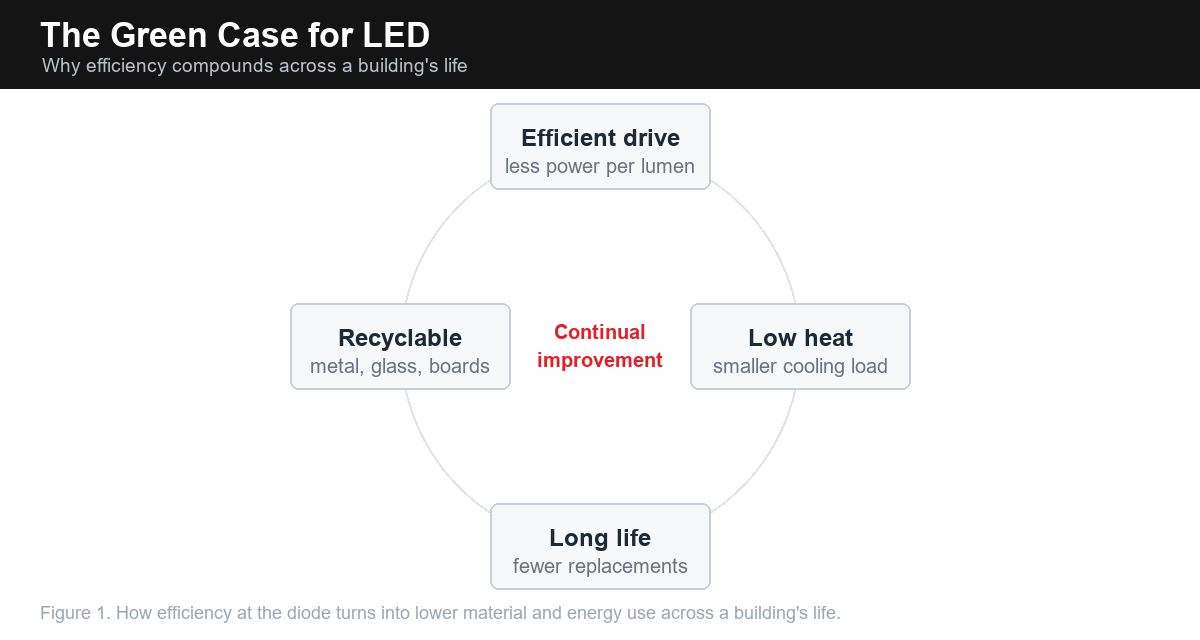
Where the Energy Savings Come From
More lumens per watt. LEDs convert roughly 100–200 lm/W versus ~15 lm/W for incandescent and ~60–100 lm/W for fluorescent/HID.
No wasted heat in a reflector. Light is emitted where it is aimed, so little is lost inside a housing.
Long life, fewer replacements. Rated for a long service life, so the manufacturing and disposal burden of lamp swaps drops sharply.
Smart dimming. An LED wall can track ambient light and dim at night, cutting draw exactly when the content does not need full output.
Green Without the Trade-Off
The old criticism of efficient lighting was "it looks weak." LED removed that: high efficacy and high peak brightness coexist, because brightness comes from packing efficient diodes, not from burning more power. On a VP LED wall that means a daylight-readable screen that still keeps its energy budget in check.
What to Specify for a Low-Impact Install
| Goal | What we specify |
|---|
| Lower power | Right-sized brightness (indoor 600–1,000 nits, not over-spec'd) |
| Long service life | COB/GOB packaging, long rated service life |
| Less waste | Front-service modules, no full-cabinet scrap |
Technical Note: Energy, Carbon and Payback
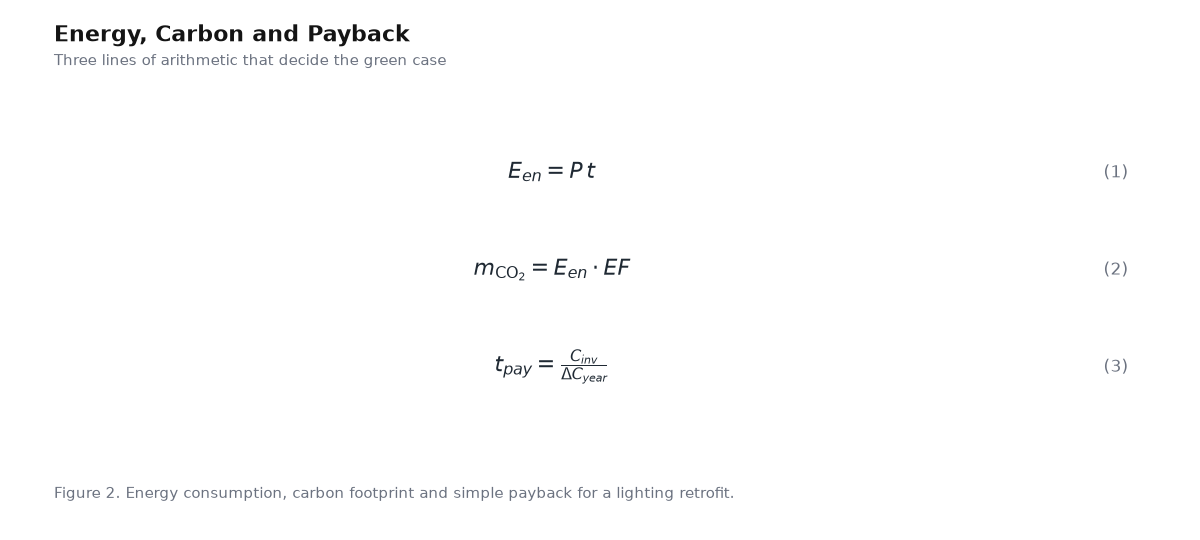
Equation (1) is the energy consumed: power P (kW) times running hours t. Equation (2) converts that energy into carbon using the grid emission factor EF (kg CO₂ per kWh). Equation (3) gives simple payback: the investment Cinv divided by the yearly saving ΔC - which is why efficacy and running hours, not sticker price, decide whether a retrofit pays.
Request a Quote
Tell us your brightness need, viewing distance and operating hours and we will size a wall that meets the brief at the lowest practical power draw.
Email: info@visionprox.com
Related Reading
References & Standards
Authoritative background and standards on the technologies discussed above:
Academic References
Peer-reviewed and preprint research supporting the technical points above:
Related VP LED products: MIP P0.9 Micro LED Display · COB P1.25 Indoor LED Display


