"LED is the future of lighting" stopped being a prediction years ago — it is simply the present. LED has become the default light source in phones, cars, offices, stadiums and, increasingly, the giant screens above them. The reason is not fashion; it is a stack of engineering advantages that older lamp technologies cannot close.
At VP LED we build the most demanding end of that stack: large-format displays that must stay readable in full daylight and survive life on the road. The same properties that made LED the future of lighting are what let us build a wall that reads clearly at 5,000 nits under the noon sun.
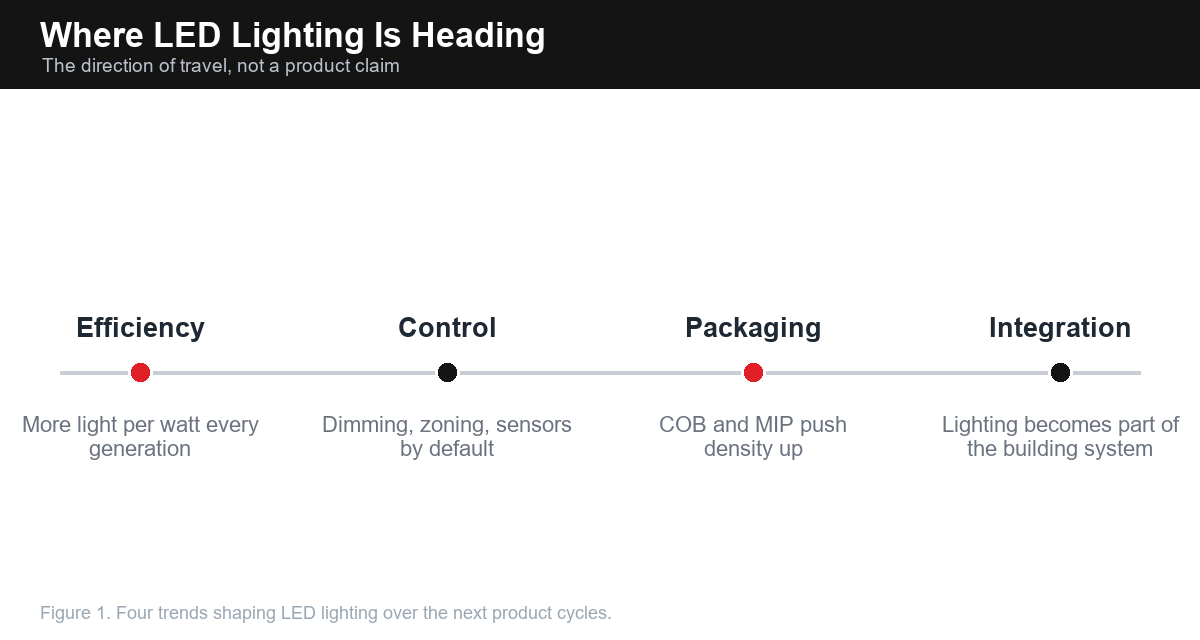
What Made LED Win
Efficacy. Modern LEDs turn 100–200 lumens per watt into light, multiple times the output of the incandescent and fluorescent lamps they replaced.
Lifespan. A long service life, with heat, humidity, dust and running hours deciding how long the wall stays at its best.
Instant, flicker-free response. No warm-up, no mercury, smooth dimming from full to zero.
Small, solid-state and directional. Light goes where it is aimed, so little is wasted in reflectors and housings.
From Room Lights to Video Walls
The jump from an LED bulb to an LED video wall is smaller than it looks. Both are arrays of the same red, green and blue diode clusters; the wall simply packs millions of them into a surface and drives each cluster as a pixel. The engineering problems scale up — seam matching, cooling, calibration, rugged cabinets — but the underlying device is the same proven semiconductor.
| Attribute | LED lamp | LED video wall |
|---|
| Output unit | Lumens (light) | Nits (screen brightness) |
| Colour | Fixed white point | Per-pixel RGB, full video |
| Typical life | Long rated service life | Long rated service; output falls to half gradually |
Why That Matters for Your Wall
Because the device is mature and efficient, we can specify a wall for almost any job: a quiet 600–1,000 nits indoor lobby, or an outdoor COB build at 4,500–5,000 nits (custom to 14,000 nits) that still draws reasonable power and runs cool. The "future of lighting" is now the foundation your content stands on.
Technical Note: Degradation and Accelerated Aging: The Math
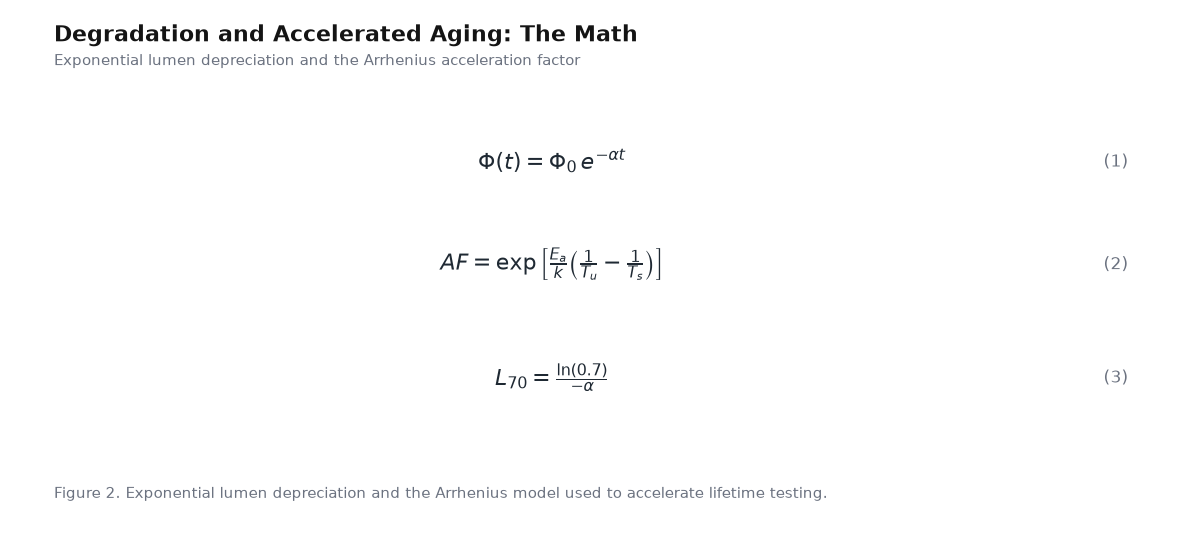
Equation (1) models lumen depreciation: flux Φ falls exponentially from Φ₀ at rate α set by package quality and environment. Equation (2) is the Arrhenius acceleration factor, with Ea the activation energy (eV), k the Boltzmann constant, Tu the use temperature and Ts the stress temperature - hotter test chambers buy test time, but only if the failure mechanism is the same. Equation (3) converts the depreciation rate into the L70 point where output drops to 70%.
Request a Quote
Send us your wall size, viewing distance and indoor/outdoor + fixed/rental conditions. We will specify packaging, pixel pitch and brightness — with a transparent bill of materials.
Email: info@visionprox.com
Related Reading
References & Standards
Authoritative background and standards on the technologies discussed above:
Academic References
Peer-reviewed and preprint research supporting the technical points above:
Related VP LED products: MIP P0.9 Micro LED Display


