"How do LED lights measure up?" is really two questions: against the lamps they replace, and against the job you need them to do. The short answer is that LED measures up on every metric that costs money or energy — and on a video wall those same metrics decide whether your content is readable or invisible.
At VP LED we talk about display performance in nits, contrast and pixel pitch rather than lumens and CRI, but the underlying idea is identical: measure the thing that matters to the viewer, then engineer to it.
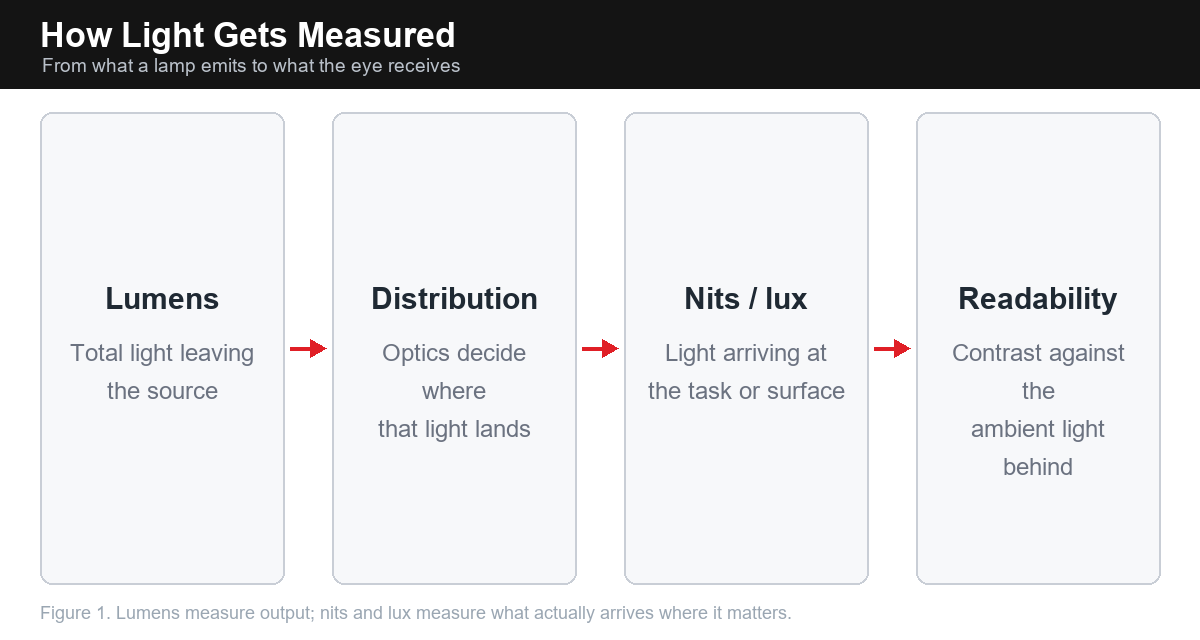
The Metrics That Matter
| Metric | Lighting | LED display |
|---|
| Output | Lumens (lm) | Candela per m² (nits) |
| Efficacy | lm/W | nits per watt (efficiency) |
| Colour quality | CRI (Ra) | Gamut, grey-scale, colour temp |
| Lifespan | Long rated service life | Long rated service; output falls to half gradually |
| Sharpness | n/a | Pixel pitch (mm) |
Why Nits, Not Lumens, for a Wall
A lamp's lumens tell you total light output; a screen's nits tell you how bright each square metre is, which is what decides readability against ambient light. Our indoor panels run 600–1,000 nits and our outdoor COB series 4,500–5,000 nits (custom to 14,000 nits) — figures chosen so the wall wins against the room or the sky behind it, not just against a dark lab.
Reading the Spec Sheet Honestly
Brightness must match the environment — over-spec indoor, under-spec outdoor, and the wall fails either way.
Pixel pitch must match the viewing distance — finer than the eye can use is wasted spend.
Lifespan and service decide total cost of ownership, not just sticker price.
Technical Note: From Lumens to Readability
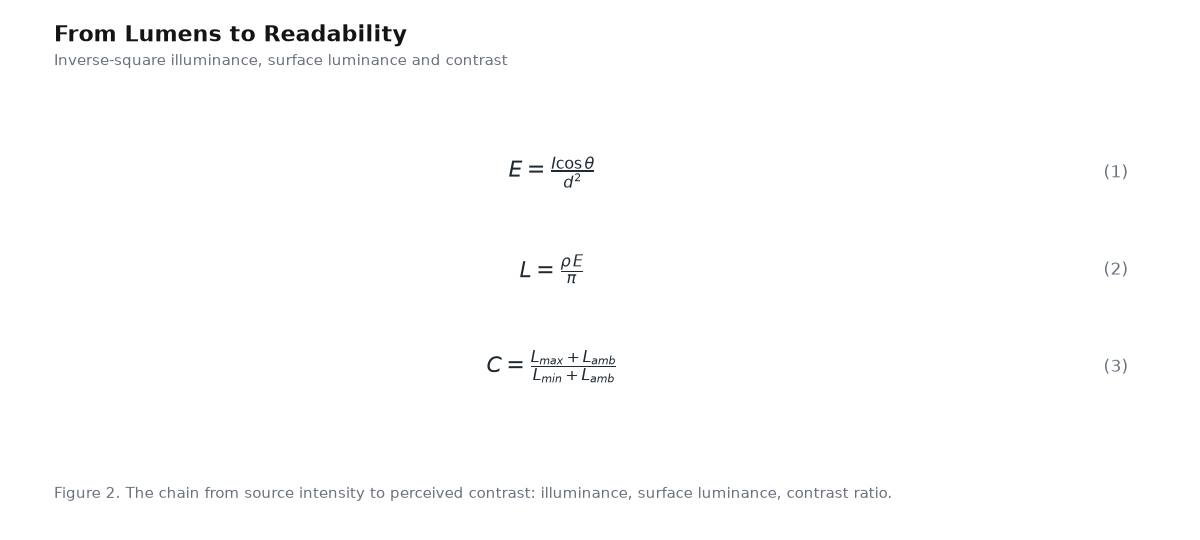
Equation (1) is the inverse-square law: illuminance E from source intensity I (cd) at distance d falls with distance squared and the cosine of the incidence angle. Equation (2) converts illuminance into surface luminance for a diffuser of reflectance ρ. Equation (3) is the ambient contrast ratio: ambient light Lamb adds equally to the bright and dark states, which is why washing out, not the panel, decides readability.
Request a Quote
Send us your viewing distance, ambient-light conditions and content type and we will translate them into the right brightness, pitch and packaging.
Email: info@visionprox.com
Related Reading
References & Standards
Authoritative background and standards on the technologies discussed above:
Academic References
Peer-reviewed and preprint research supporting the technical points above:
Related VP LED products: Mirror LED Poster P1.5 · CBV P1.95 COB Rental LED Display


