For a large image in a dark room, projection has been the cheap default for decades. The moment ambient light comes up or the screen has to be a permanent, bright, daylight-readable surface, LED takes over. The choice comes down to where the screen lives and how it is viewed.
At VP LED we build for the cases projection cannot handle — daylight, high ambient light and seamless large format. Our outdoor COB series holds 4,500–5,000 nits, so it reads where a projector would be invisible.
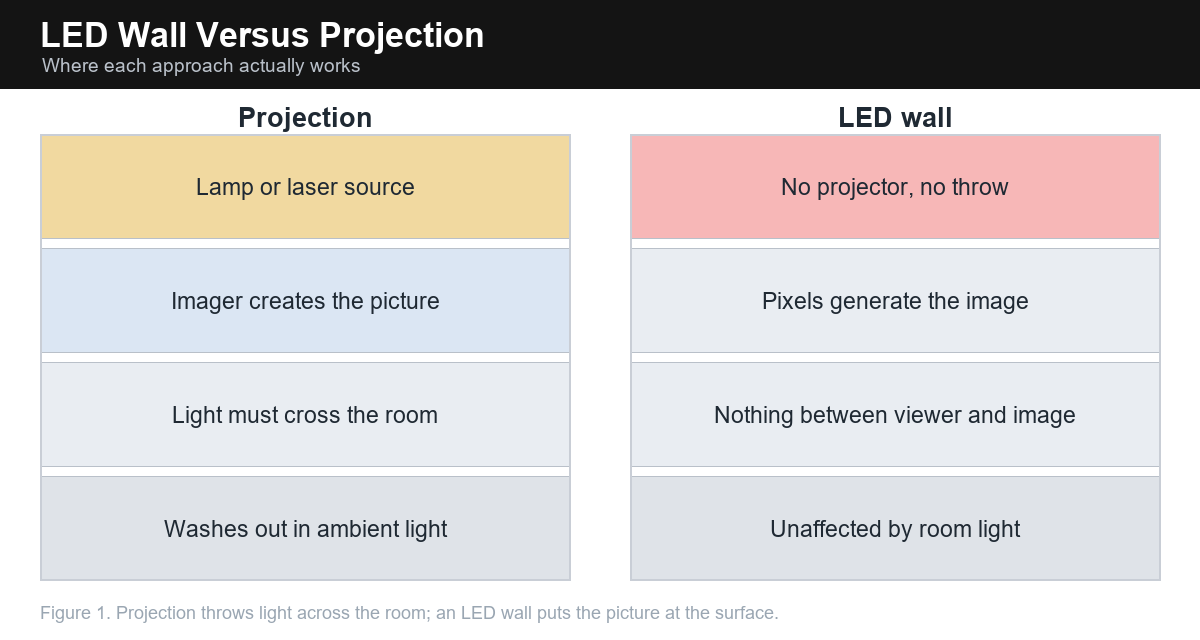
How They Compare
| Factor | Projection | LED |
|---|
| Ambient light | Needs a dark room; washes out in light | Reads in daylight at 4,500+ nits |
| Contrast | Greys out as ambient light rises | Self-emitting; true black holds |
| Space | Needs throw distance behind the screen | Flat wall, no depth required |
| Maintenance | Lamps degrade and need replacement | No lamps to replace; long service life |
| Seamlessness | Single image, but limited size | Any size, no bezels |
When Projection Still Fits
A very large passive surface in a controlled dark space — cinema, planetarium dome, dark auditorium — where the cheaper upfront cost wins and ambient light is never an issue.
Budget-constrained temporary installs that will never face daylight.
The moment the screen meets a lit room, a window or the outdoors, LED is the only option that stays visible.
VP LED's Fit
For events and outdoor campaigns we use fine-pitch rental and the outdoor COB line at 4,500–5,000 nits. Because we build P1.2 / P1.5 / P1.9 in both fixed and rental, a brand can run the same pitch on a touring stage and a fixed facade — something projection cannot match for brightness or ruggedness.
Technical Note: Screen Illuminance and Gain
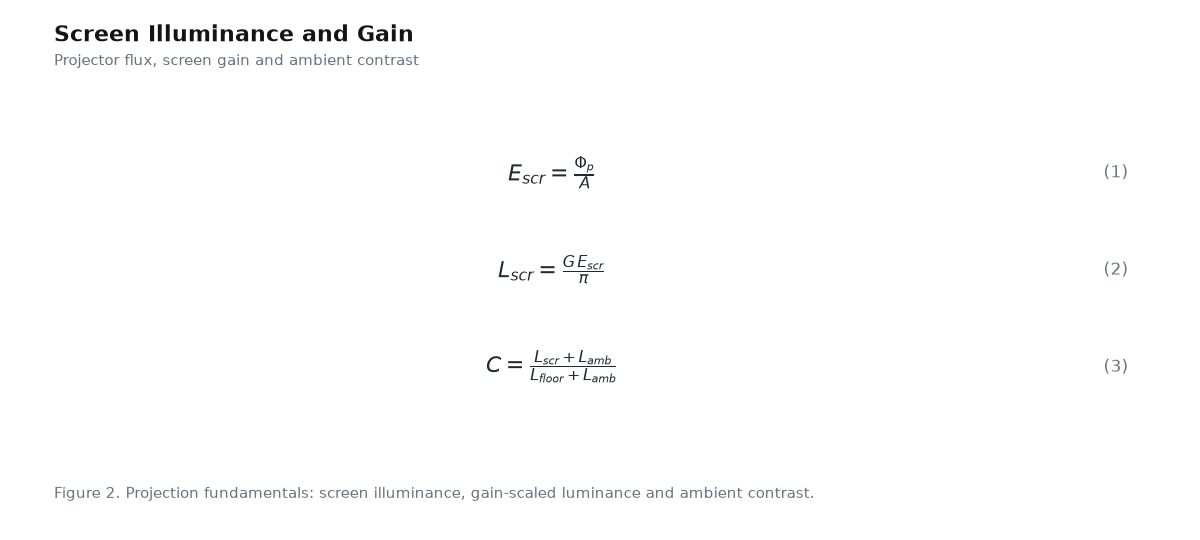
Equation (1) spreads the projector's flux Φp over screen area A - make the image bigger and every square metre gets dimmer, the fundamental projection trade-off. Equation (2) converts that to screen luminance through the screen gain G. Equation (3) is the contrast the room actually delivers: ambient light reflected by walls and the screen itself (Lfloor) stacks onto the black state, which is why bright rooms defeat projectors before panel quality even matters.
Frequently Asked Questions
Is LED always more expensive than projection?
Upfront, often yes for a small screen. But once you add lamp replacements, the dark-room requirement and the inability to use the space in daylight, LED usually wins on total cost for any lit environment.
Can LED replace a projection mapping setup?
For flat and gently curved surfaces, yes, with better brightness and no projector shadows. For complex 3D projection mapping onto irregular architecture, projection still has a role — but that is a creative niche, not a bright-signage one.
Request a Quote
Tell us your venue, light conditions, size and fixed/rental needs. We will compare LED vs projection for your case and specify the right build.
Email: info@visionprox.com
Related Reading
References & Standards
Authoritative background and standards on the technologies discussed above:
Academic References
Peer-reviewed and preprint research supporting the technical points above:
Qian, Y.; Yang, Z.; Hsiang, E.-L.; Wu, S.-T. et al. Human Eye Contrast Sensitivity to Vehicle Displays under Strong Ambient Light. Crystals 2023, 13(9), 1384.
Chang, S.-H.; Huang, C.-H.; Lin, C.-C.; Kuo, H.-C. et al. Improving Mini-LED Pattern Quality by Using Distributed Bragg Reflector and Digital Twin Technology. Crystals 2022, 12(4), 529.
Wang, S.; Liu, X.; Shi, L. et al. Research on heat dissipation of high power consumption LED display. SID Symposium Digest of Technical Papers 55(1), 2024.
Related VP LED products: DOF P5 Outdoor Fixed LED Display · DGF P10 Outdoor Fixed LED Display


