"LED vs LCD" is the comparison buyers actually mean when they shop for a large screen. They are not the same technology, and the difference decides whether your image reads in sunlight, seams or stays seamless, and how big you can go. At VP LED we build the LED side — so here is the honest contrast.
How Each One Makes a Picture
An LCD is a layer of liquid crystals that blocks or passes light from a separate backlight; colour and brightness come from that backlight shining through. An LED display is self-emissive — every pixel is a cluster of red, green and blue diodes that make their own light. No backlight, no liquid-crystal layer.
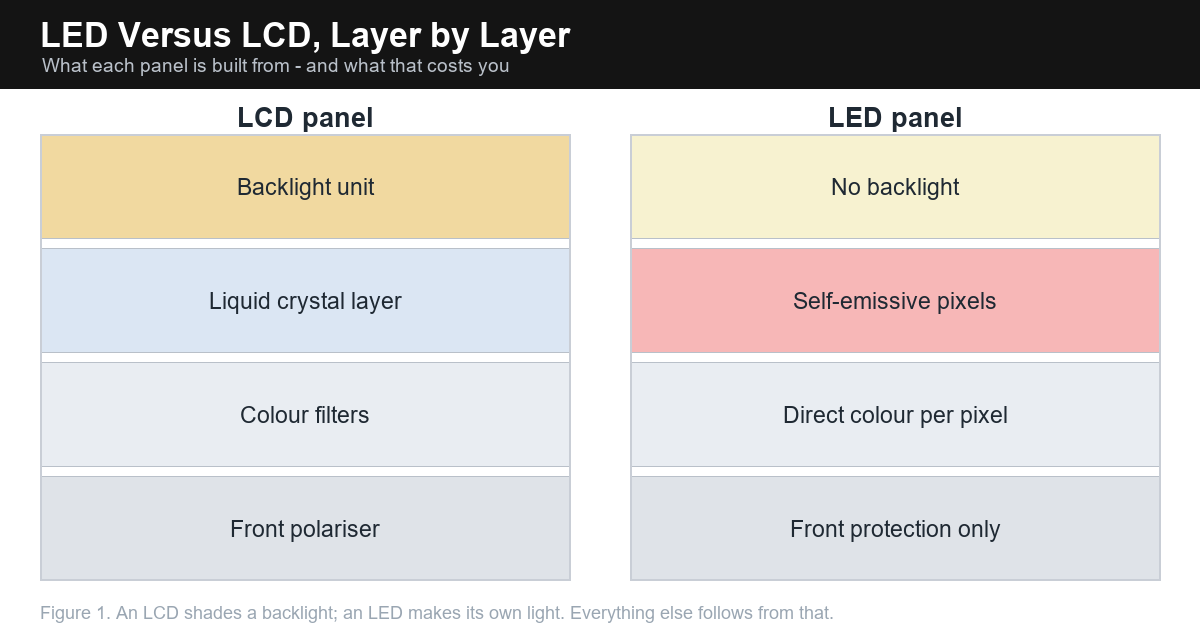
Side-by-Side
| Factor | LCD (panel / TV) | LED display (wall) |
|---|
| Light source | Backlight behind crystals | Each pixel self-emissive |
| Brightness | ~300–500 nits typical | 600–1,000 indoor; 4,500–5,000+ outdoor (custom 14,000) |
| Seams | Bezel between panels | Seamless, no bezel |
| Size limit | Single panel size | Any size, cabinets tile out |
| Sunlight | Washes out easily | Reads clearly at high nits |
| Viewing angle | Narrower, colour shifts | Wide, stable colour |
Where LCD Still Makes Sense
Single-panel use under controlled indoor light — a desk monitor or a meeting-room screen.
When a hard bezel seam is acceptable and budget is tight.
When the content never needs daylight brightness.
Where LED Wins
Any wall that must be large, seamless, bright or outdoor. Our indoor panels run 600–1,000 nits; our outdoor COB series holds 4,500–5,000 nits in daylight (custom to 14,000), and because there is no bezel, the wall reads as one continuous image from any angle.
Technical Note: Transmission Stacks and Gamma
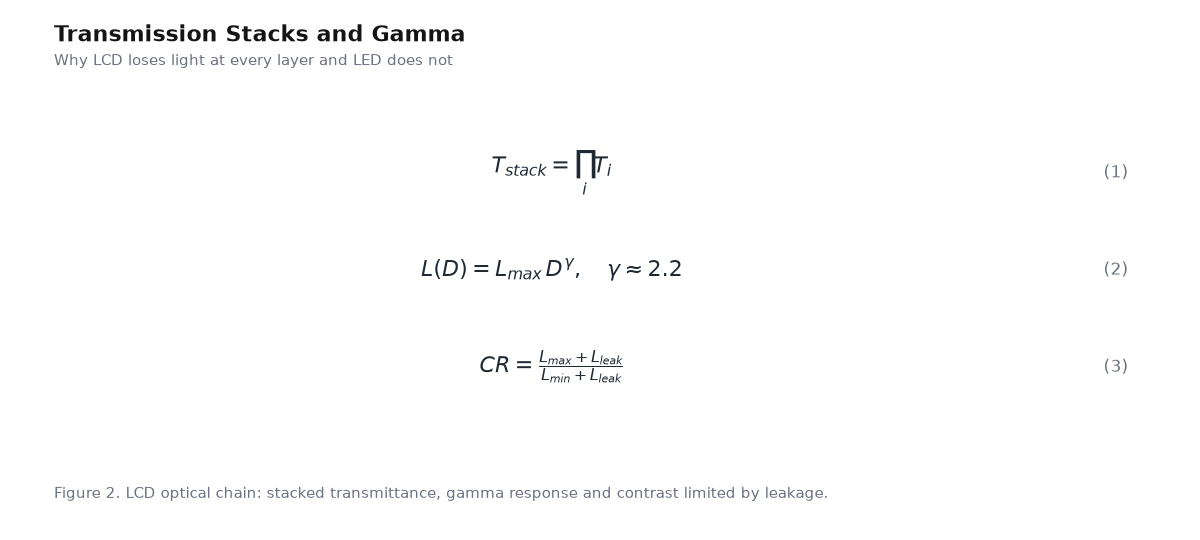
Equation (1) is the LCD's core problem: transmittance multiplies across backlight, polarisers, liquid crystal and colour filters, so even strong layers leave only a few percent of the light - an LED wall, being self-emissive, has no such product. Equation (2) is the gamma response that maps digital level D to luminance. Equation (3) shows contrast limited by the leakage Lleak that a backlight always provides; a switched-off LED pixel has no leakage at all.
Request a Quote
Tell us your size, viewing distance and indoor/outdoor + fixed/rental conditions and we will specify LED versus LCD honestly — and size the right wall if LED is the answer.
Email: info@visionprox.com
Related Reading
References & Standards
Authoritative background and standards on the technologies discussed above:
Academic References
Peer-reviewed and preprint research supporting the technical points above:
Qian, Y.; Yang, Z.; Hsiang, E.-L.; Wu, S.-T. et al. Human Eye Contrast Sensitivity to Vehicle Displays under Strong Ambient Light. Crystals 2023, 13(9), 1384.
Ashraf, M.; Chapiro, A.; Mantiuk, R.K. Resolution limit of the eye: how many pixels can we see? arXiv:2410.06068 (2024); published in Nature Communications 16, 2025.
Ke, S.; Xue, X.; Jin, R.; Chen, Z. et al. Compromising circadian performance and color gamut Rec. 2020 for achieving healthy LED displays. Optik 2023, 282, 170864.
Related VP LED products: MIP P0.9 Micro LED Display · COB P1.25 Indoor LED Display


