When a specification calls for a high-output light — a car headlamp, a stadium floodlight, a street lantern — the choice used to be between an LED and an HID (High-Intensity Discharge) lamp such as metal halide or high-pressure sodium. Both are bright, but they are built on different physics, and that difference shows up in running cost, lifespan and how the light behaves the instant you switch it on.
At VP LED we live on the same LED side of that divide — except our product is the large-format wall, not the luminaire. The reasons we bet on LED (efficacy, durability, instant response) are exactly the reasons it now dominates new lighting and display installs alike.
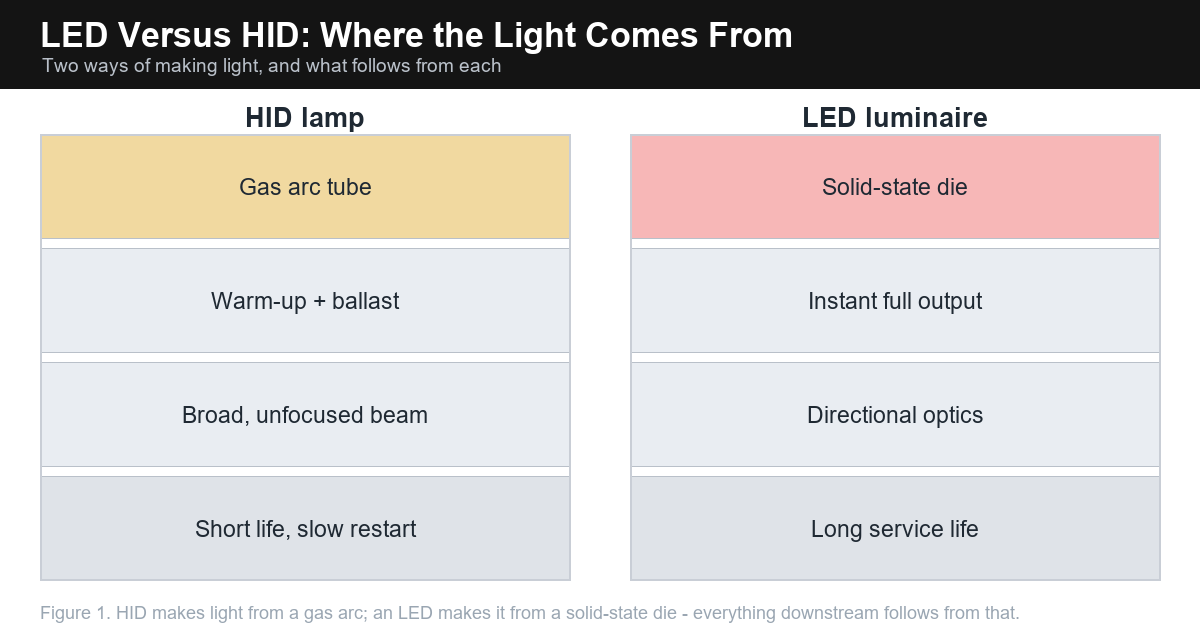
How LED and HID Generate Light
An HID lamp strikes an electric arc through a gas; the arc heats metal vapour until it glows, and a separate reflector throws that glow forward. An LED is a solid-state diode: current through a semiconductor junction emits photons directly, with no arc, no gas and no warm-up delay.
| Property | HID (metal halide / sodium) | LED |
|---|
| Warm-up | Seconds to minutes; restrike delay after outage | Instant on, no restrike delay |
| Efficacy | ~80–100 lm/W | ~100–200 lm/W |
| Rated life | 10,000–24,000 hours | Longer rated life; no lamp or filament to replace |
| Directionality | Omnidirectional; needs reflectors | Emits where aimed; little loss |
| Dimming | Poor, often stepped | Smooth, flicker-free to zero |
Why LED Wins on the Spec Sheet
Efficacy. LED converts more watts into light and less into heat, so the same brightness draws less power.
Lifespan. A quality LED is rated in the tens of thousands of hours; an HID lamp is a consumable you schedule replacements around.
Instant response. No warm-up, no restrike delay after a momentary outage — important for safety and signage.
Ruggedness. No fragile arc tube or filament; solid-state parts survive vibration and shock.
The Same Physics Powers a Daylight-Readable Wall
The efficacy and ruggedness that let an LED streetlight run for a decade with no maintenance are the same properties that let our outdoor COB series hold 4,500–5,000 nits in direct sun — with custom daylight builds to 14,000 nits — while drawing far less power than the legacy lamp it replaces. For a permanent outdoor wall or a touring stage, that is the whole argument in one line: LED stays bright, runs cool and does not quit.
Technical Note: Efficacy: The Equation Behind the Electricity Bill
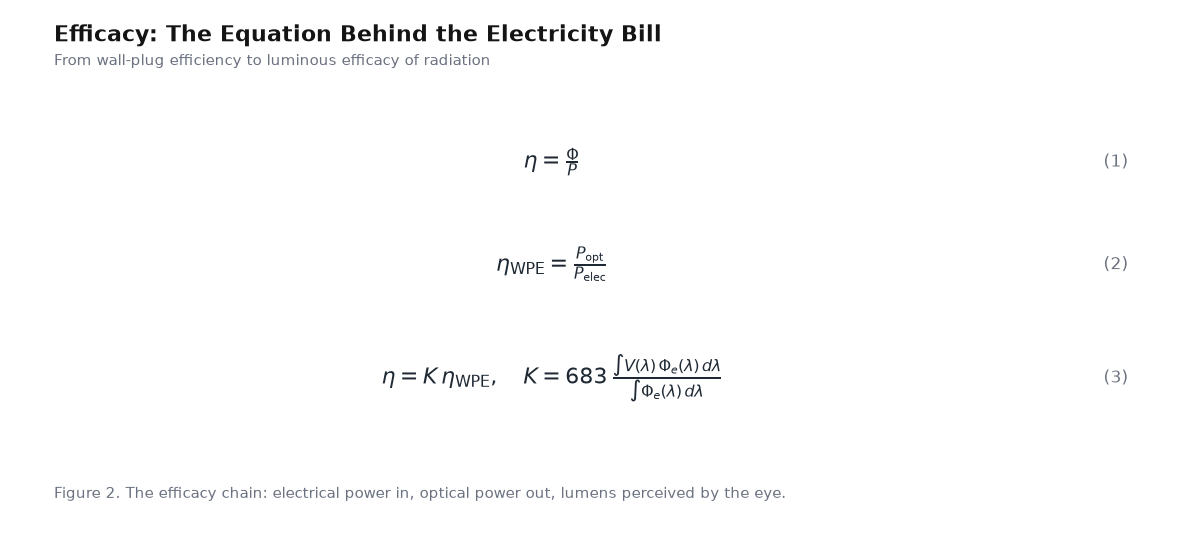
Equation (1) defines luminous efficacy η as lumens of flux Φ per watt of input power P. Equation (2) is wall-plug efficiency, the ratio of optical output power to electrical input. Equation (3) links the two through K, the luminous efficacy of radiation, computed from the photopic response V(λ) weighted over the emitter spectrum Φe(λ); for white light K sits near 300 lm/W, well below the 683 lm/W monochromatic maximum.
Request a Quote
Tell us your application, viewing distance and power or brightness target and we will specify the right LED platform for your project, with a transparent quote and full bill of materials.
Email: info@visionprox.com
Related Reading
References & Standards
Authoritative background and standards on the technologies discussed above:
Academic References
Peer-reviewed and preprint research supporting the technical points above:
Related VP LED products: DGF P10 Outdoor Fixed LED Display · DOF P5 Outdoor Fixed LED Display


