No — an LED screen is not the same as an LCD screen, even though the names sound alike and shops often label both "LED." The difference is in how the picture is made, and it changes everything about brightness, seams and size.
The Core Difference
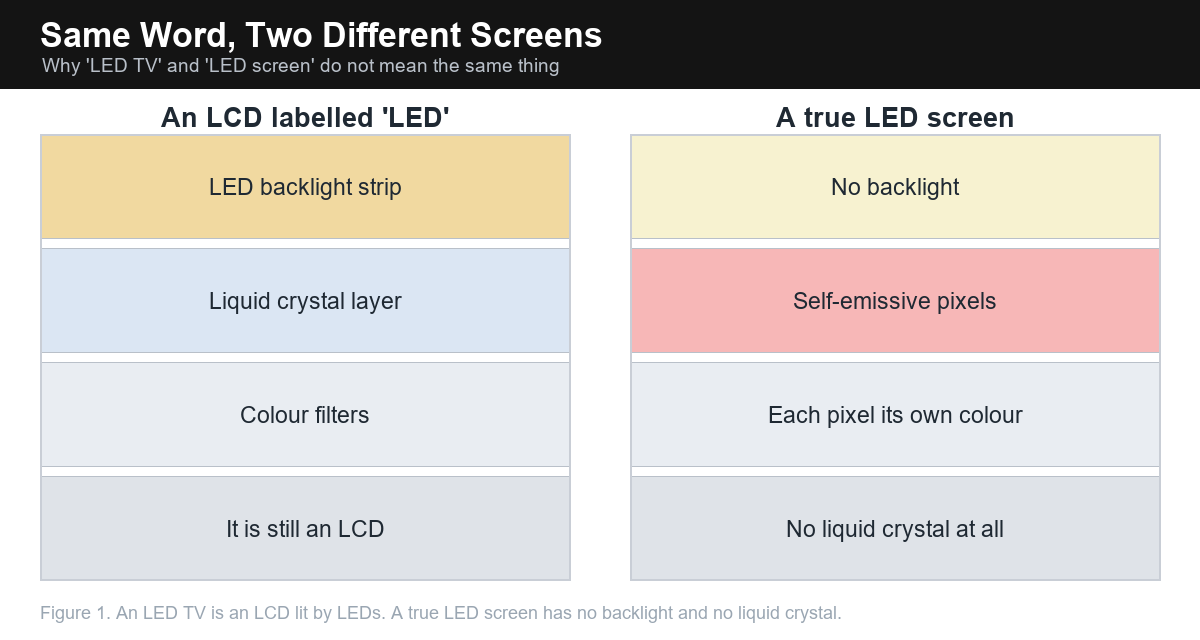
An LCD has a backlight behind a layer of liquid crystals; the crystals open and close to shape the image, but the light itself comes from elsewhere. An LED screen is self-emissive — every pixel is a diode cluster that produces its own light and colour. No backlight, no liquid crystal.
What That Means in Practice
| Question | LCD | LED screen |
|---|
| Who makes the light? | A backlight behind the panel | Each pixel, directly |
| How bright? | ~300–500 nits | 600–1,000 indoor; 4,500–5,000+ outdoor |
| Bezel between tiles? | Yes, visible seams | No — seamless surface |
| Readable in sunlight? | Poorly | Yes, at high nits |
A Common Point of Confusion
"LED TV" is usually an LCD panel lit by an LED backlight — still an LCD at heart. A true LED screen (the kind VP LED builds) has no LCD layer at all; the diodes themselves are the pixels. So "LED" in a TV label and "LED" in a video wall mean two different things.
When to Choose Which
LCD — a single panel indoors, controlled light, a hard seam is fine, budget is tight.
LED screen — large, seamless, bright, or outdoor; anything where the wall must read as one image in any light.
Our outdoor COB series (4,500–5,000 nits, custom to 14,000) and indoor MIP P0.9 / COB P1.25 are the LED-screen answer when LCD runs out of road.
Technical Note: Grayscale and Gamma
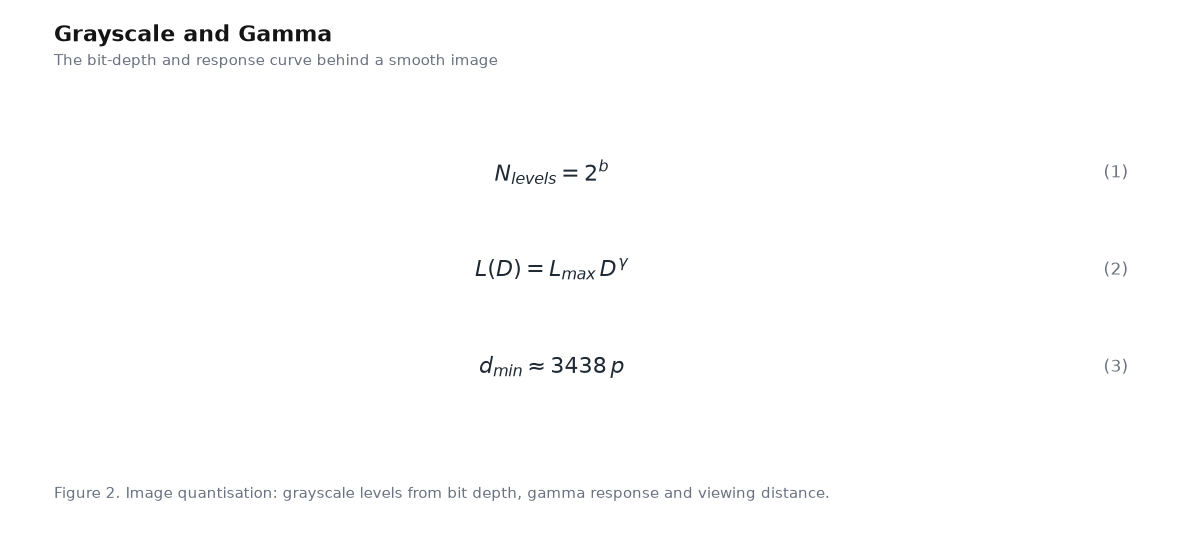
Equation (1) gives the number of brightness levels from bit depth b: 16-bit processing yields 65,536 steps, which is why deep-grayscale drivers hold dark scenes smooth where 8-bit ones band. Equation (2) is the gamma response mapping digital level D to luminance; getting gamma right in the driver is what keeps shadows from crushing. Equation (3) sets the closest seamless viewing distance from pitch p.
Request a Quote
Tell us your size, viewing distance and indoor/outdoor + fixed/rental needs. We will recommend LCD or LED straight, then spec the right wall.
Email: info@visionprox.com
Related Reading
References & Standards
Authoritative background and standards on the technologies discussed above:
Academic References
Peer-reviewed and preprint research supporting the technical points above:
Ashraf, M.; Chapiro, A.; Mantiuk, R.K. Resolution limit of the eye: how many pixels can we see? arXiv:2410.06068 (2024); published in Nature Communications 16, 2025.
Ke, S.; Xue, X.; Jin, R.; Chen, Z. et al. Compromising circadian performance and color gamut Rec. 2020 for achieving healthy LED displays. Optik 2023, 282, 170864.
Related VP LED products: TX P0.9 Indoor Fixed LED Display


