
Support
Virtual pixel pitch — also called pixel sharing — is a driving technique that makes a wall look finer than its physical LED pitch. It does not add real pixels; it changes how the existing ones are lit so the eye perceives more detail. Understanding the difference matters, because some suppliers sell "virtual P2" on a physical P4 panel, and the two are not the same thing.
At VP LED we specify true physical pitch to your viewing distance first. Our fine-pitch lines use genuinely dense physical pixels (COB and MIP down to P0.9), so we do not need to fake sharpness — but on a budget-constrained coarse wall, virtual pitch can still help, and we will tell you exactly what it does and does not do.
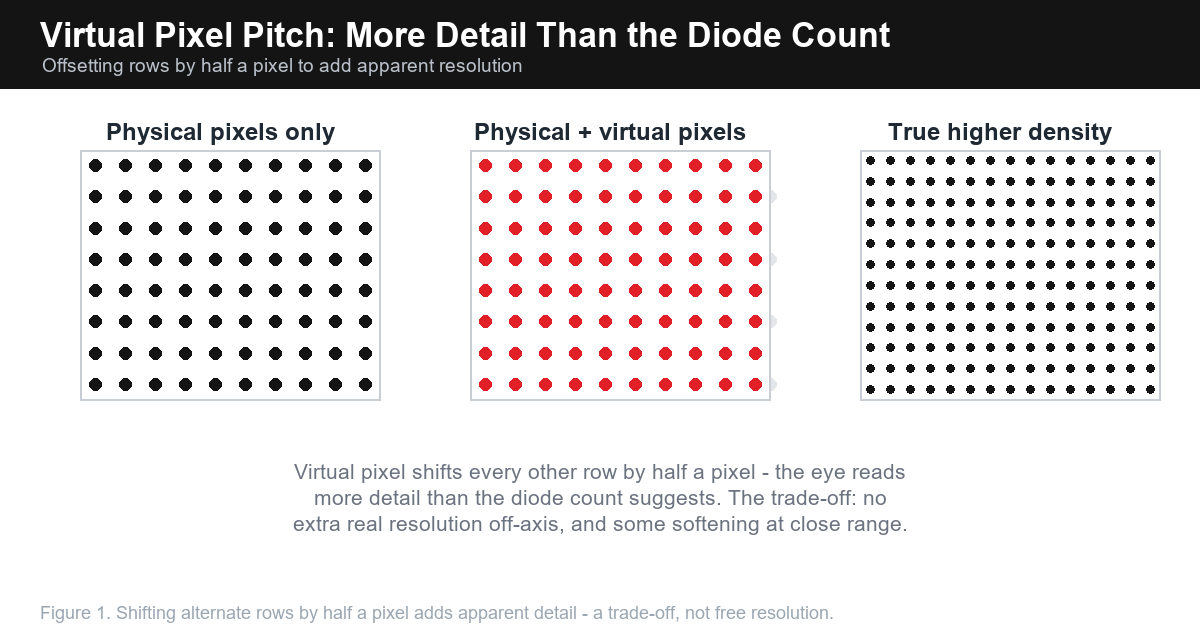
How Virtual Pitch Works
A physical LED pixel is a fixed cluster of red, green and blue diodes. In a virtual-pixel system the controller drives each physical pixel to share its colour with neighbouring pixels over time and space — by lighting adjacent clusters in patterned sequences, the eye fuses them into a finer perceived grid. A P4 panel can thus present as an effective P2 for certain content.
What It Actually Buys You
| Content type | Virtual pitch helps? |
|---|---|
| Static text and simple graphics | Yes — edges and strokes look smoother on coarse pitch |
| Gradients and flat colour fields | Yes — banding reduces visibly |
| Fine photographic detail | No — there is no real pixel data to recover |
| Fast motion / video | No — can introduce shimmer and colour fringing |
The Honest Trade-off
Virtual pitch is a perception aid, not extra resolution. It cannot recover detail that was never captured, and on motion it can introduce artefacts. It is a reasonable way to smooth text on a cost-driven coarse wall, but it is never a substitute for specifying the right physical pitch for your viewing distance — which is why our pixel pitch guide leads with real pitch, not virtual.
VP LED's Stance
Where the brief allows, we recommend a true fine-pitch COB or MIP panel (see the MIP P0.9) so sharpness is real, not simulated. Where budget forces coarse pitch, we will state plainly what virtual pitch will and will not improve before you commit.
Technical Note: Apparent Resolution and the Eye's Limit
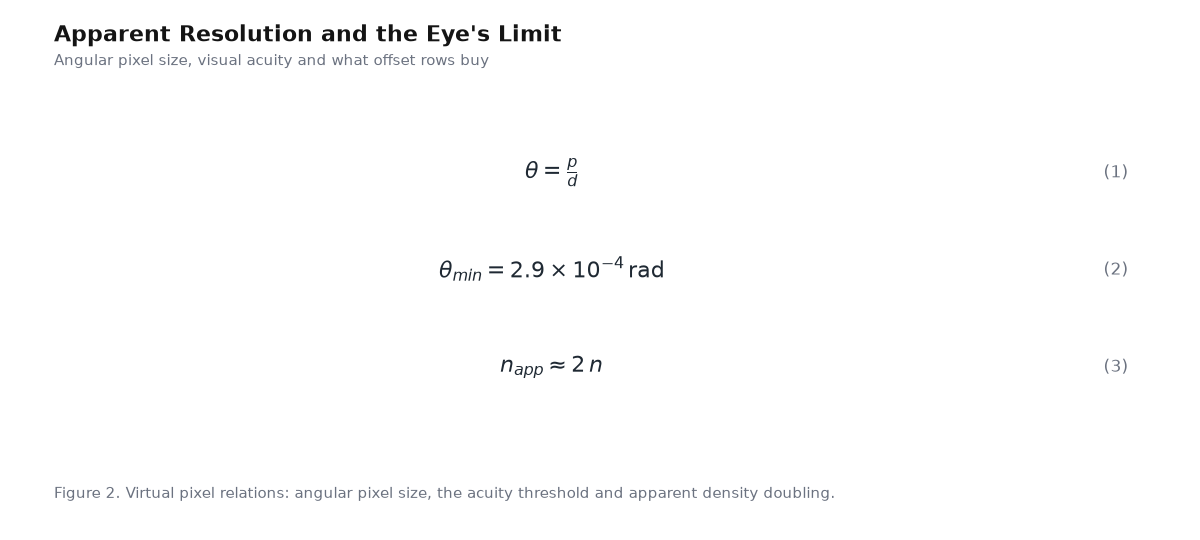
Equation (1) computes the angular size of one pixel: pitch p seen from distance d. Equation (2) is the limit of human acuity, about one arc-minute (2.9×10⁻⁴ rad) for 20/20 vision - pixels subtending less than this are beyond the eye no matter what the spec sheet says. Equation (3) is the virtual-pixel claim: shifting alternate rows by half a pitch roughly doubles apparent pixel count, though the true optical resolution stays at n, which is why the effect fades off-axis and up close.
Frequently Asked Questions
Is virtual pitch the same as a finer panel?
No. A finer physical panel has more real diodes and more real resolution. Virtual pitch only reshuffles how existing diodes are perceived; the underlying pixel count is unchanged.
Should I buy virtual pitch to save money?
Only if your content is mostly text and static graphics viewed from the panel's designed distance. For photo-real or video content, spend the budget on true pitch instead.
Request a Quote
Send us your content type, viewing distance and budget. We will recommend true physical pitch versus a virtual-pitch coarse panel — with the trade-offs spelled out.
Email: info@visionprox.com
Related Reading
References & Standards
Authoritative background and standards on the technologies discussed above:
Academic References
Peer-reviewed and preprint research supporting the technical points above:
Related VP LED products: MIP P0.9 Micro LED Display · COB P1.25 Indoor LED Display
© 2011-2026 Vision Productions Co.,Ltd | All Rights Reserved

XINHONGFENG INDUSTRIAL PARK, LOUGANG AVENUE, LOUGANG COMMUNITY, SONGGANG BOULEVARD, BAO'AN DISTRICT, SHENZHEN, PRC.
+86-0755-28281147


