
Support
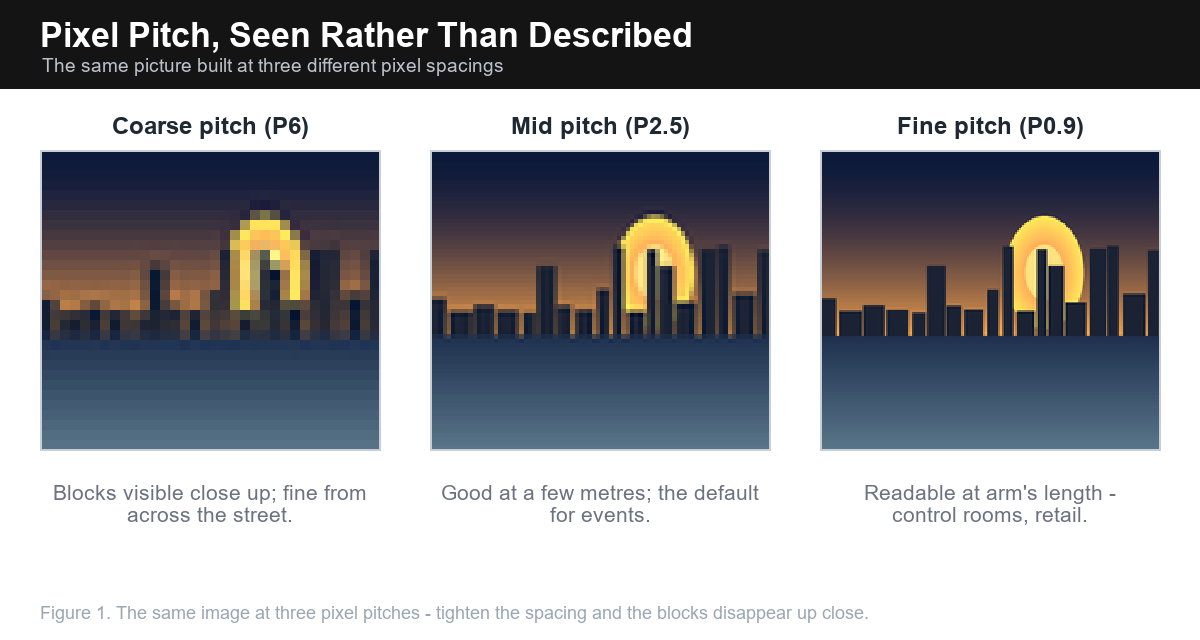
Pixel pitch is the centre-to-centre distance between two adjacent pixels on an LED module, measured in millimetres. It is the one number that decides both how sharp the wall looks and how close a viewer can stand before the image turns into a grid. Smaller pitch means more pixels packed into the same area; larger pitch means fewer, bigger pixels built for distance.
At VP LED we set pitch from the installation's real viewing distance, not from a spec-sheet race. Our fine-pitch line runs from MIP P0.9 micro-LED through COB P1.25 indoors, and out to the outdoor COB P1.2 / P1.5 / P1.9 series — the last of these holding 4,500–5,000 nits in daylight, with custom builds to 14,000 nits. The rest of this article explains the trade-offs in plain engineering terms so you can pick a pitch with confidence.
Pixel Density: What Pitch Really Buys You
Pitch sets how many pixels fit in a square metre. Drop from P2.5 to P1.25 and you quadruple the pixel count in the same area; drop to P0.9 and it is roughly eight times denser. That is why fine pitch costs more — you are paying for several times the diode count. Typical densities across real products:
| Pitch | Technology | Pixels per m² | Typical brightness |
|---|---|---|---|
| P0.9 | MIP Micro LED | ≈ 1.23M | 600–1,000 nits (indoor) |
| P1.25 | COB Indoor | 640,000 | 600–1,000 nits (indoor) |
| P1.5–1.9 | GOB / Outdoor COB | 277,000–444,000 | 600 nits / 4,500–5,000 nits (outdoor) |
| P2.5 | SMD / COB | 160,000 | up to 5,000 nits (outdoor) |
| P6–P10 | SMD Outdoor | 10,000–28,000 | 5,000–8,000+ nits |
Matching Pitch to Viewing Distance
The finer the pitch, the closer a viewer can stand and still see a seamless image; the coarser the pitch, the farther the audience needs to be. In practice the bands fall out like this:
P0.9–1.25 — control rooms, broadcast, close-up retail where people stand a metre or two away.
P1.5–1.9 — indoor lobbies and fine-pitch outdoor at mid distance, a few metres out.
P2.5–3.91 — stages, event rental and large indoor signs viewed from several metres.
P6–P10 — roadside billboards and stadium fascias read from tens of metres.
The rule we apply: choose the coarsest pitch whose density still clears your nearest viewer, then spend the saved budget on brightness and ruggedness rather than on resolution nobody can see.
Why Fine Pitch Is Hard Outdoors
As pitch shrinks, each LED die shrinks too, so a smaller fraction of the panel surface actually emits light. That is the core reason most suppliers cannot offer fine pitch outdoors. SMD keeps a black matrix between packages, so below about P1.5–1.8 the emitters are too small to reach sunlight brightness. COB bonds the diodes straight to the board and seals them under one continuous surface with almost no dead space — which is why our outdoor COB P1.2 / P1.5 / P1.9 still holds 4,500–5,000 nits. MIP packages the die tightly enough to reach P0.9 indoors at 600–1,000 nits (see the MIP P0.9).
Packaging Sets the Floor on Pitch
The package type caps how fine you can go: SMD bottoms out around P1.5–1.8 because the 3-in-1 surface-mount body has a fixed footprint; GOB is limited by the SMD underneath; COB and MIP remove the package entirely and reach P0.9. That is why a fine-pitch requirement usually drives the choice toward COB or MIP rather than SMD.
VP LED's Pitch Advantage
We run P1.2 / P1.5 / P1.9 in both fixed and rental builds, and outdoor rental at those fine pitches is something few suppliers offer. For a touring show that must read from a few metres in daylight, that combination — fine pitch, rental-grade ruggedness and 4,500+ nits — is exactly what our COB Outdoor P1.5 is built for.
Technical Note: Pitch, Distance and Pixel Count
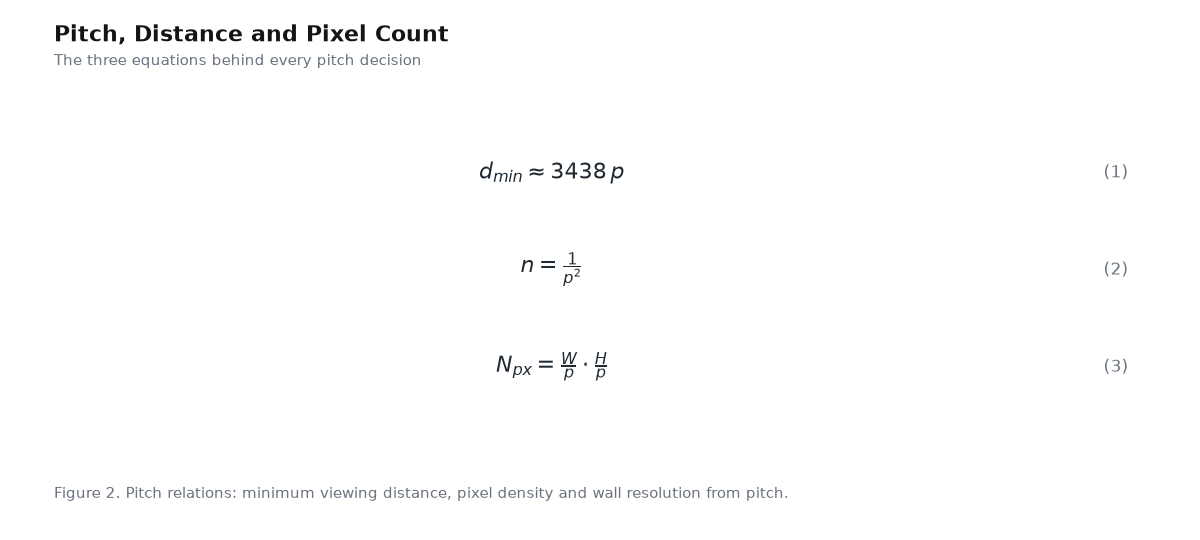
Equation (1) converts pitch to the closest distance at which a 20/20 viewer sees a seamless image: 3438 times the pitch in metres, from one arc-minute acuity. Equation (2) is the density law - pixels per square metre scale with the inverse square of pitch, which is why each step finer carries a sharp cost. Equation (3) gives the wall's true pixel resolution from its physical size W, H and pitch p; size and pitch together, not pitch alone, decide the picture.
Frequently Asked Questions
Does a smaller pitch always look better?
Finer pitch helps only while the eye can still resolve the extra pixels at your viewing distance. Beyond that, a tighter pitch often adds cost more than visible quality. In most cases the viewing distance should set the pitch.
How do I size a wall from pitch?
Divide the cabinet's millimetre dimensions by the pitch to get pixels per cabinet, then multiply by the number of cabinets. A 500×500mm cabinet at P1.25 gives 400×400 pixels; at P2.5 it is 200×200. Wall resolution is simply cabinets times pixels-per-cabinet.
Why is fine-pitch outdoor more expensive?
You pay for diode count (density rises sharply as pitch falls) and for the COB or MIP packaging needed to keep brightness up at small pixel size. Our cost guide breaks the price factors down.
Request a Quote
Send us your nearest and farthest viewing distances, wall dimensions, and indoor/outdoor + fixed/rental conditions. We will specify the coarsest pitch that still meets your sharpness target, then choose packaging and brightness — with a transparent bill of materials.
Email: info@visionprox.com
Related Reading
References & Standards
Authoritative background and standards on the technologies discussed above:
Academic References
Peer-reviewed and preprint research supporting the technical points above:
Related VP LED products: TX P1.5 Indoor Fixed LED Display · COB P1.25 Indoor LED Display
© 2011-2026 Vision Productions Co.,Ltd | All Rights Reserved

XINHONGFENG INDUSTRIAL PARK, LOUGANG AVENUE, LOUGANG COMMUNITY, SONGGANG BOULEVARD, BAO'AN DISTRICT, SHENZHEN, PRC.
+86-0755-28281147


