Lighting quality, not just quantity, drives how people perform in an office. LED made it practical to control that quality — colour temperature, colour rendering, flicker and dimming — precisely enough that workplace studies consistently link good LED lighting to fewer errors, less eye strain and better mood.
At VP LED we build large-format LED displays, but the same physics underpins both: high colour rendering, stable flicker-free light and long, predictable life. A control-room or lobby wall we ship runs on those same principles.
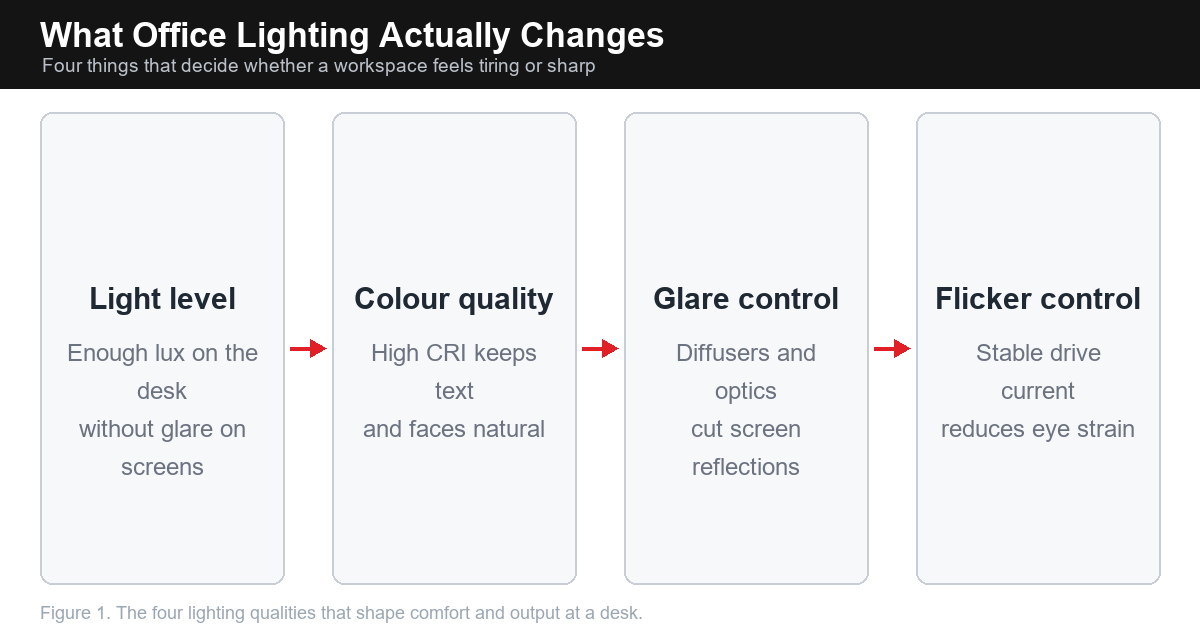
What Good Office LED Lighting Changes
Colour rendering (CRI). High-CRI LED shows materials and faces accurately, reducing the subtle strain of distorted colour.
Tunable colour temperature. Cooler light for focused tasks, warmer light to wind down — supporting the body's circadian rhythm.
Flicker-free drive. Quality LED is driven to avoid the sub-visible flicker that causes headaches over a long shift.
Dimming and zoning. Light follows the task and the daylight, not a single fixed level.
Why It Lifts Productivity
Consistent, glare-free, well-rendered light keeps people alert and cuts the small errors that accumulate through a day. The gain is modest per person but real across a whole floor — and it compounds with the energy saving LED brings versus legacy fluorescent.
VP LED's Angle
The same criteria we apply to a wall — stable light, accurate colour, long life — are why LED displaced older technologies in displays too. See what an LED display is for the display side of the same story.
Technical Note: The Numbers Behind Office Lighting
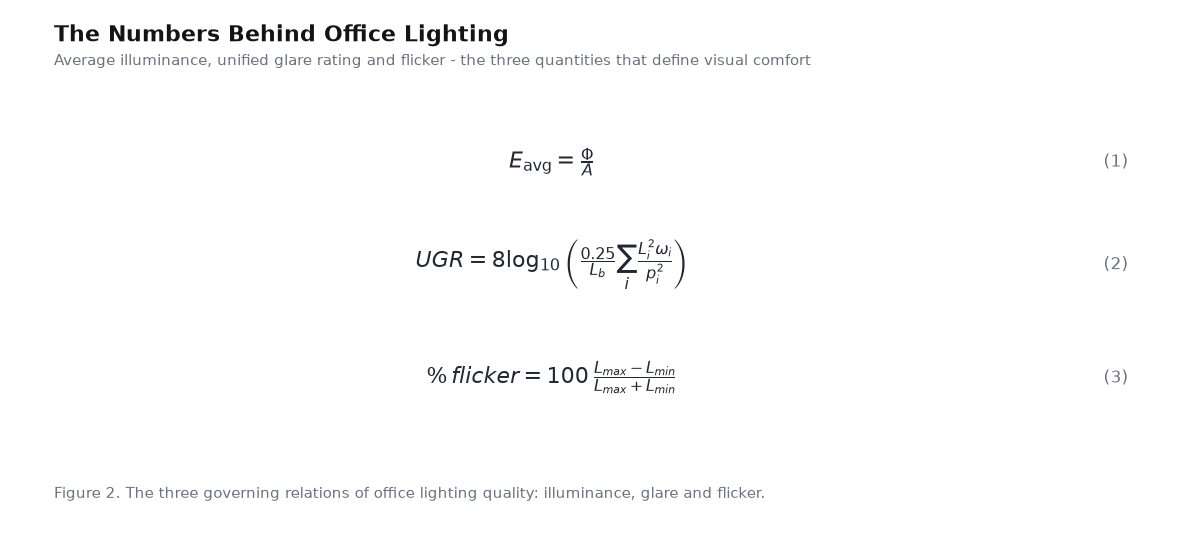
Equation (1) gives the average illuminance E on the workplane from the luminous flux Φ (lumens) spread over area A (m²). Equation (2) is the CIE unified glare rating, where Lb is the background luminance (cd/m²), Li the luminance of each luminaire, ωi its solid angle and pi its Guth position index. Equation (3) defines percent flicker from the maximum and minimum luminance within one modulation cycle.
Request a Quote
Planning a lobby, control room or briefing-space display? Tell us the space, viewing distance and lighting conditions. We will specify pitch, brightness and colour handling for it.
Email: info@visionprox.com
Related Reading
References & Standards
Authoritative background and standards on the technologies discussed above:
Academic References
Peer-reviewed and preprint research supporting the technical points above:
Related VP LED products: P1.9 / P2.5 Indoor Fine-Pitch LED Display · IFS P1.5 Indoor Fixed LED Display


