
Support
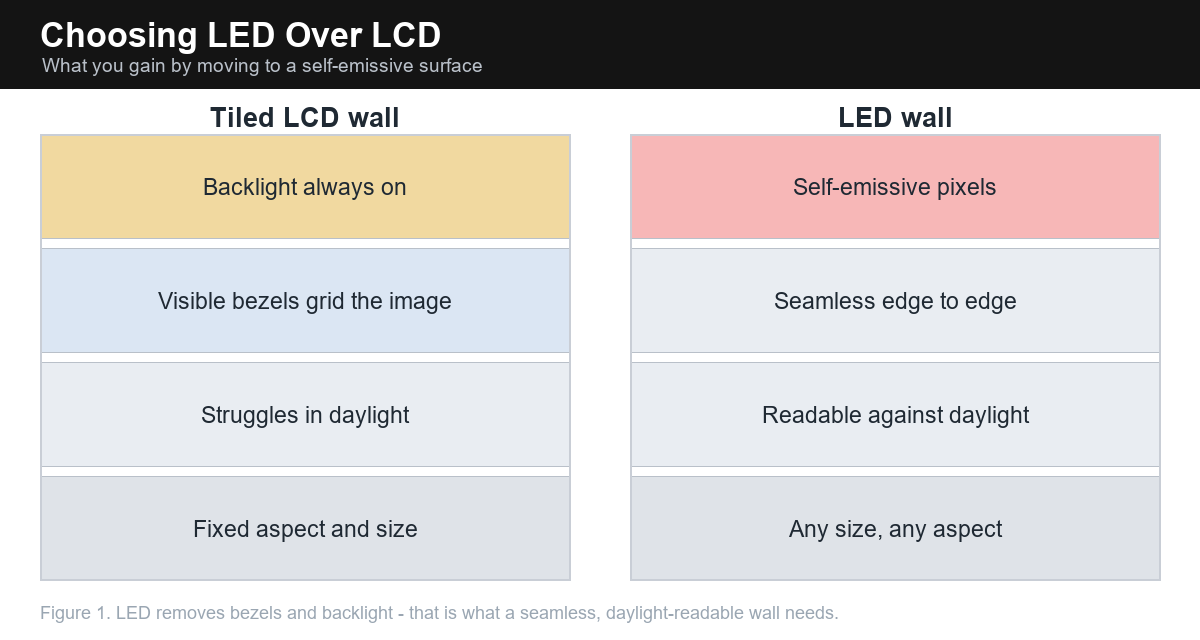
When a screen has to be large, bright and seamless, LED wins over LCD on the points that actually matter in the field. The two technologies are often confused because both show video, but they behave very differently once the panel is more than a metre across or the lights come up.
At VP LED we build walls precisely where LCD fails — daylight, large format and seamless surfaces. Our outdoor COB series holds 4,500–5,000 nits so it reads at noon, and our fine-pitch indoor lines (down to MIP P0.9) give a sharp image close up where an LCD video wall would show bezels.
Brightness and Daylight
An LCD panel typically peaks at 300–700 nits. That is fine on a desk in an office, but it washes out the moment sunlight or strong ambient light hits it. An LED wall makes its own light at thousands of nits, so it stays readable in a shop window or a building face. For any outdoor or high-ambient install, this alone decides the choice.
Seamlessness
LCD "video walls" are tiled panels with bezels — usually 1.7–3.5mm of dead border per panel. Across a wall that reads as a visible grid. An LED wall has no bezel; cabinets lock into one continuous surface, so the image is unbroken at any size.
Size and Viewing Angle
LCD panels cap out around 55–98 inches; going larger means more tiles and more seams, and colour shifts badly off-axis. LED scales to any dimension and holds colour across a wide audience. For a control room, a stage or a facade, LCD simply runs out of road.
When LCD Is Still the Right Call
Small, close, desk-side viewing where a single panel is enough.
Controlled indoor light and a tight budget — LCD is cheaper per inch at small sizes.
Fine static text viewed from centimetres away, where sub-millimetre pixel density beats a wall's pitch.
VP LED's Positioning
Because we run fine pitch in both fixed and rental, and hold 4,500–5,000 nits outdoors, a client can replace a tiled LCD wall with a seamless LED surface that also works in daylight — something LCD cannot do.
Technical Note: Ambient Contrast: LED Versus LCD
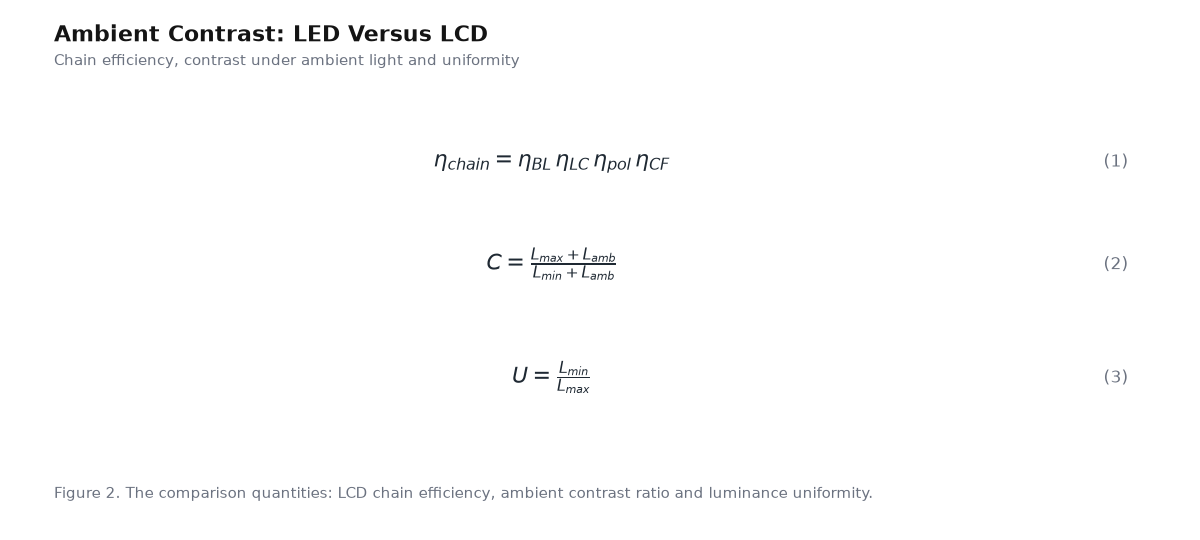
Equation (1) is the LCD's cascaded efficiency, the reason its backlight must run hundreds of watts to deliver a bright picture. Equation (2) is ambient contrast: adding Lamb to numerator and denominator compresses the range, and the panel with the lower black level keeps the higher score. Equation (3) is luminance uniformity, minimum over maximum - seamless LED cabinets hold U above 0.9 across the wall, while tiled LCD bezels break the surface before brightness even enters the comparison.
Frequently Asked Questions
Can LCD ever match LED brightness?
Not in daylight. High-bright LCDs reach perhaps 2,000 nits in rare cases, still below our outdoor COB range, and at far higher cost per square metre. In sun, LED is the only practical option.
Is an LED wall harder to install than LCD?
It is a different skill, not a harder one — cabinets lock together and front-service, whereas a large LCD video wall needs careful bezel alignment and still shows seams. We supply a full bill of materials and install guidance.
Request a Quote
Send us your size, viewing distance and light conditions. We will specify pitch, packaging and brightness — and show where LED beats an LCD wall for your case.
Email: info@visionprox.com
Related Reading
References & Standards
Authoritative background and standards on the technologies discussed above:
Academic References
Peer-reviewed and preprint research supporting the technical points above:
Related VP LED products: MIP P0.9 Micro LED Display · COB P1.25 Indoor LED Display · P1.9 / P2.5 Indoor Fine-Pitch LED Display
© 2011-2026 Vision Productions Co.,Ltd | All Rights Reserved

XINHONGFENG INDUSTRIAL PARK, LOUGANG AVENUE, LOUGANG COMMUNITY, SONGGANG BOULEVARD, BAO'AN DISTRICT, SHENZHEN, PRC.
+86-0755-28281147


